Hanji
CLOB

Examined the OnchainCLOB and Trie contracts: order management, asset custody, and the radix trie order-matching structure.
report id
0580
category
DeFi & Yield
language
Solidity
final report
November 3, 2025
lines of code
2541
Content

Download audit report

1

Executive Summary

This document presents the results of the security review conducted by Nethermind Security for Hanji’s OnchainCLOB and Trie contracts. Hanji is a fully onchain order book exchange, where all orders are placed, matched and managed onchain. Users are able to create market orders or limit orders, with a choice on whether the order should only be posted without executing, or to execute immediately. The OnchainCLOB contract provides functions for users to manage their orders and handles asset deposit withdrawals, while the Trie contract contains a radix trie implementation for storing and matching user’s orders.

The audit comprises 2541 lines of Solidity code. The audit was performed using (a) manual analysis of the codebase, and (b) automated analysis tools, and (c) creation of test cases.

Audit assessment
Audit TypeSecurity Review
Initial ReportAugust 28, 2025
Final ReportNovember 3, 2025
Initial Commit Hash4c8237da4e
Final Commit Hash512320f21c
Documentation AssessmentMedium
Test Suite AssessmentHigh
Total findings
10
Fixed
8
Acknowledged
2
Mitigated
0
Unresolved
0

Findings by severity

  • Critical0
  • High2
  • Medium0
  • Low0
  • Informational5
  • Best Practices3

2

Audited Files

#ContractLoCCommentsRatioBlankTotal
1src/Errors.sol3638.3%241
2src/ITradeConsumer.sol4375.0%29
3src/IOnchainCLOBFactory.sol20315.0%225
4src/ITrie.sol12325.0%217
5src/IWatchDog.sol5360.0%210
6src/IWETH.sol5360.0%210
7src/WatchDog.sol50510.0%1974
8src/Proxy.sol5360.0%412
9src/WatchDogFactory.sol381128.9%1160
10src/OnchainCLOBFactory.sol1013130.7%18150
11src/ITrieFactory.sol4375.0%29
12src/Helper.sol1965025.5%31277
13src/Trie.sol87728532.5%2291391
14src/OnchainCLOB.sol102326025.4%1711454
15src/IOnchainCLOB.sol13332.3%19155
16src/FP24.sol23939.1%1042
17src/TrieFactory.sol9888.9%522
Total254168627.0%5313758

4

System Overview

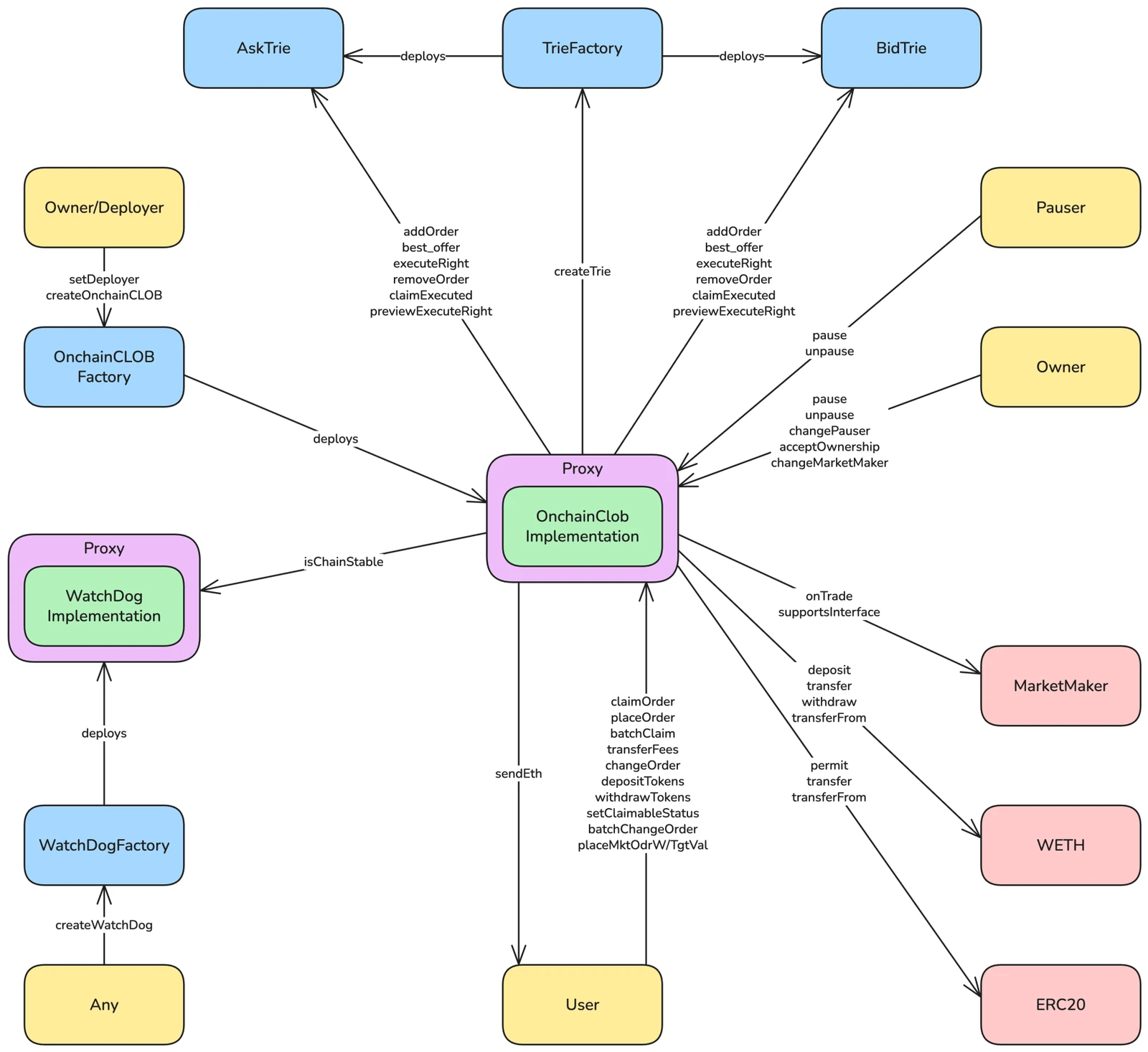
The Hanji onchain order book protocol primarily consists of three separate contract types: The OnchainCLOB, Trie, and the Watchdog. Some contracts also have factories associated with them, which are shown in the contract interaction diagram in the following subsection.

OnchainCLOB: The primary contract through which both users and permissioned roles interact. Users can place market or limit orders, with options to execute immediately or post only to the order book. This contract also manages token deposits, withdrawals, and overall asset management. To optimize gas costs for high-frequency traders, it includes functionality for storing idle capital directly within the contract, reducing repeated transfer overhead. Orders may be cancelled or claimed even when only partially filled, with the choice to withdraw the associated assets or leave them in the contract under internal accounting.

Trie: This contract is deployed twice, once for tracking bid orders and once for tracking ask orders. Its entry points are strictly restricted, permitting access only from the OnchainCLOB contract. Orders are stored efficiently in a radix trie and can be executed and claimed either fully or partially.

Watchdog: This contract functions as a safeguard against chain-level issues that block transaction processing. Each interaction with the watchdog updates a timestamp recording the last activity. If transactions cannot be processed for a sufficiently long period, the watchdog prevents the OnchainCLOB from placing new orders. This mechanism provides a grace period in which pending orders can be removed or adjusted, mitigating risks from potential market shifts during times when the chain temporarily prevents order modifications.

4.1 Contract Interaction Diagram

Diagram from the audit report

5

Risk Rating Methodology

The risk rating methodology used by Nethermind Security follows the principles established by the OWASP Foundation. The severity of each finding is determined by two factors: Likelihood and Impact.

Likelihood measures how likely the finding is to be uncovered and exploited by an attacker. This factor will be one of the following values:

  1. High: the issue is trivial to exploit and has no specific conditions that need to be met;
  2. Medium: the issue is moderately complex and may have some conditions that need to be met;
  3. Low: the issue is very complex and requires very specific conditions to be met.

When defining the likelihood of a finding, other factors are also considered. These can include but are not limited to motive, opportunity, exploit accessibility, ease of discovery, and ease of exploit.

Impact is a measure of the damage that may be caused if an attacker exploits the finding. This factor will be one of the following values:

  1. High: the issue can cause significant damage, such as loss of funds or the protocol entering an unrecoverable state;
  2. Medium: the issue can cause moderate damage, such as impacts that only affect a small group of users or only a particular part of the protocol;
  3. Low: the issue can cause little to no damage, such as bugs that are easily recoverable or cause unexpected interactions that cause minor inconveniences.

When defining the impact of a finding, other factors are also considered. These can include but are not limited to data and state integrity, loss of availability, financial loss, and reputation damage. After defining the likelihood and impact of an issue, the severity is determined according to the table below.

Impact / LikelihoodLowMediumHigh
HighMediumHighCritical
MediumLowMediumHigh
LowInfo / Best PracticesLowMedium
UndeterminedUndeterminedUndeterminedUndetermined

To address issues that do not fit a High, Medium or Low severity, Nethermind Security also uses three more finding severities: Informational, Best Practices, and Undetermined.

  1. Informational findings do not pose any risk to the application, but they carry some information that the audit team intends to pass to the client formally;
  2. Best Practice findings are used when some piece of code does not conform with smart contract development best practices;
  3. Undetermined findings are used when we cannot predict the impact or likelihood of the issue.

6

Issues

6.1 Proxy orders use the owner’s deposited funds instead of the proxy’s funds

FileFix commitTypeStatus
src/OnchainCLOB.solPR #71HighFixed

The placeOrderByProxy(...) function allows an approved proxy address to place orders on behalf of a user (order_owner). This functionality is intended for Request-for-Quote (RFQ) systems, where a market maker acts as the proxy to execute a trade for a user. The expected behavior is that the proxy (msg.sender) provides the funds for the order it initiates.

However, the underlying payment logic in the _handleTokenTransfer(...) function does not distinguish between a proxy order and a regular order. When sourcing funds, the function first depletes the order_owner’s internal token balance (traderBalances) before requesting any funds from the proxy.

The placeOrderByProxy(...) function calls the internal _placeOrder(...) function, which in turn calls _handleTokenTransfer(...) to manage the movement of assets.

function placeOrderByProxy(
// ...
address order_owner,
// ...
) public payable /* ... */ {
// ...
// @audit Calls _placeOrder with the user as `order_owner` but msg.sender as the proxy.
ExecutionResult memory result = _placeOrder(
// ...
order_owner
);
// ...
}

The core issue lies within _handleTokenTransfer(...), where client is the order_owner. The logic first checks and uses the client’s deposited funds.

function _handleTokenTransfer(
address client, // @audit This is the `order_owner`
...
) internal {
// ...
// processing token_x
if (x_to_send < x_to_receive) {
// ...
uint128 clients_shares = traderBalances[client].token_x;
// @audit It the `order_owner` has enough balance then funds are taken from their balance
if (clients_shares >= shares_to_receive) {
traderBalances[client].token_x -= shares_to_receive;
// ...
}
}
// ...
if (actual_token_x_to_receive > 0) {
_safeTransferFromWithBalanceCheck(
token_x,
msg.sender, // @audit If user's balance doesn't cover the full order, proxy pays the rest
address(this),
actual_token_x_to_receive
);
}
// ...
}

Instead of the proxy covering the full cost of the order, the user’s already existing funds in the OnchainCLOB contract are used first. As an example attack, this vulnerability can be exploited by a malicious user with proxy permissions who can use the placeOrderByProxy(...) function to create spread in the orderbook, and then create orders on behalf of the user that match with their own, moving back and forth within the created spread, to effectively arbitrage funds out of the user and into the malicious proxy account.

Recommendation

Consider modifying the token transfer logic to differentiate between orders placed directly by a user and those placed by a proxy.

Resolution

Fixed in commit 32439ce7. The function placeMarketOrderWithTargetValueByProxy has also been implemented.

6.2 OnchainCLOB markets with non-native token pairs can be halted

FileFix commitTypeStatus
src/OnchainCLOB.solPR #69HighFixed

The OnchainCLOB contract supports ERC20 token pairs where one of the tokens can be a wrapped native asset (e.g., Wrapped Ether). This is controlled by the storage variable supports_native_eth, which, if set to true, indicates that the market accepts the chain’s native assets as payment. Internally, the native asset is converted into the wrapped ERC20 token during deposits and converted back into the native asset during withdrawals.

Token inflow and outflow for order execution are handled in the _handleTokenTransfer function. It determines the net inbound or outbound transfer amount for each token, performs conversions between wrapped and native assets as needed, and executes the transfers. At the end of the function, a balance check is performed to convert any remaining native assets into wrapped assets. This is shown below:

function _handleTokenTransfer(...) internal {
// ...
// Depositing WETH
if (address(this).balance > 0) {
weth.deposit{value: address(this).balance}();
}
}

There are multiple checks in the contract to ensure that native asset value cannot be transferred into the contract unless a wrapped native asset token is supported. These checks are present in all deposit, order, and fallback receive functions. However, an attacker can bypass these protections by using the selfdestruct opcode to forcefully transfer native assets to the contract. If this is done to a market contract that does not support native assets, the balance check will still execute. Assuming the attacker has forcefully deposited native assets using selfdestruct, the balance will read as non-zero, and the market will attempt to call deposit on the weth address variable. The weth variable is defined below:

IWETH weth = is_token_x_weth ? IWETH(address(token_x)) : IWETH(address(token_y));

A market that does not support native assets would have regular ERC20 tokens for token_x and token_y, so the weth variable would be an address that does not fully support the IWETH interface—particularly the deposit function. With native assets present on the contract, the check will still execute and the deposit call will fail, causing the transaction to revert.

The _handleTokenTransfer function is an internal function used by many other external functions. As a result, if native assets are forcefully sent to a market that does not support them, the following external functions will permanently revert: placeOrder, placeMarketOrderWithValue, claimOrder, and batchClaim. This means that users cannot make, claim, or cancel orders, effectively halting the market.

Recommendation

Consider adding an additional requirement to the balance check to ensure that supports_native_eth is true. This will ensure that the weth.deposit call only executes when the weth token is guaranteed to support the deposit function.

Resolution

Fixed in commit 51067f20.

6.3 ERC20 Permit support

FileFix commitTypeStatus
src/OnchainCLOB.sol—InfoAcknowledged

The OnchainCLOB contract supports tokens with the EIP-2612 standard, allowing users to provide signatures for allowances. There are two other notable permit implementations which are not supported by the OnchainCLOB contract: The Uniswap Permit2 and the DAI-style permit.

// EIP-2612
permit(address owner, address spender, uint value, uint deadline, uint8 v, bytes32 r, bytes32 s)
// Permit2
permit(address owner, PermitSingle memory permitSingle, bytes calldata signature)
// DAI-style
permit(address holder, address spender, uint256 nonce, uint256 expiry, bool allowed, uint8 v, bytes32 r, bytes32 s)

Recommendation

No changes are required, this finding simply notes that there may be some permit based tokens which have a different standard to what is supported by the OnchainCLOB contract. When creating a new market for ERC20 tokens, consider their permit style.

Resolution

No changes are required. We support EIP-2612 permits and will add other standards like Permit2 if needed.

6.4 Order claiming allows token transfers and is open by default

FileFix commitTypeStatus
src/OnchainCLOB.sol—InfoFixed

There are two functions that can be used to claim an order: claimOrder and batchClaim. The claimOrder function is designed to be called by a user, using the msg.sender as the order owner. The batchClaim function allows an array of addresses to be passed, meaning that the caller does not have to be the order owner in order to claim an order on behalf of another user. batchClaim will call the internal _calculateAndSendOrderPayout function with the transfer_tokens argument hardcoded to true, as shown below:

function batchClaim(address[] memory addresses, ...) external ... {
// ...
for (uint i = 0; i < addresses.length; i++) {
_calculateAndSendOrderPayout(addresses[i], order_ids[i], only_claim, true);
}
}

The OnchainCLOB contract allows for two ways to manage assets when creating and claiming orders. Users can deposit and withdraw tokens on each order to maintain custody of their assets, or, for a more gas-efficient approach which could suit entities placing frequent orders, it is possible to leave tokens in the contract and use internal accounting. By using internal accounting, token transfers are not required, which can save gas costs for these high-frequency traders.

A user can only have their order claimed on their behalf by another address if their claimable status is set to true, which is the default state when their trader ID is created. This makes it possible to claim tokens on behalf of another user and forcefully move the tokens into the user’s account. For traders frequently placing orders and making use of the internal accounting system to save gas, this opens the opportunity to "grief" these power users by forcing them to manually deposit the tokens again, requiring the user to submit token approvals and increasing their gas costs while interacting with the protocol.

Recommendation

Given that the default behavior of allowing orders to be claimable suits general users, consider allowing power users to have granular control over whether their tokens should be transferred or remain in the contract during a claim.

Resolution

User can set desired behavior with function setTraderConfig. We removed function batchClaim, supposed using batchExecute with calls of claimOrder instead. In claimOrder if msg.sender != order_owner contract will ignore provided params.

6.5 Post-only orders can be griefed via front-running

FileFix commitTypeStatus
src/OnchainCLOB.solPR #71InfoFixed

The _placeOrder(...) function allows users to submit post-only orders. These orders are designed to be passive, adding liquidity to the order book without executing against existing orders. The contract enforces this by checking if the order’s price would cross the spread. If it does, the order is considered aggressive, and the function returns without placing it.

An attacker can exploit this mechanism by front-running a user’s post-only order. By observing the transaction in the mempool, the attacker can submit their own small order that shifts the best price on the book just enough to make the victim’s subsequent post-only order appear aggressive.

// ...
if (post_only) {
bool aggressive_trade = false;
if (isAsk) {
// @audit An attacker can front-run to place a bid, making this condition true.
// Same applies for ask
if (price_id <= bidTrie.best_offer()) {
aggressive_trade = true;
}
}
// @audit If front-run, aggressive_trade becomes true.
if (aggressive_trade) {
if (msg.value > 0) {
_sendETH(msg.sender, msg.value);
}
// ...
// @audit The function returns, causing the user's order to fail.
return execution_result;
}
}
// ...

When the victim’s transaction is executed, the aggressive_trade check will pass, causing the function to return early. The user’s order is never placed, their transaction effectively becomes a no-op, and they are forced to waste gas.

Recommendation

Consider documenting the behavior clearly for users intending to use post_only orders.

Resolution

Fixed in commit 793e0b2d.

6.6 Proxy orders refund dust from msg.value to the order owner

FileFix commitTypeStatus
src/OnchainCLOB.sol—InfoAcknowledged

When a proxy places an order via placeOrderByProxy(...) and provides native ETH through msg.value, there might be a small amount of "dust" leftover. This occurs because the msg.value may not be a perfect multiple of the required token amount after scaling calculations. The protocol correctly calculates this dust but refunds it to the wrong party.

The _handleTokenTransfer(...) function handles the distribution of funds. It calculates the leftover ETH but sends it to the client address, which, in a proxy transaction, is the order_owner. The funds should be returned to msg.sender, the proxy who supplied the ETH in the first place.

function _handleTokenTransfer(
address client, // @audit This is the `order_owner` in a proxy trade.
// ...
bool withdraw_as_native_eth
) internal {
// ...
if (msg.value > 0) {
if (is_token_x_weth) {
uint128 extra_x = (msg.value / scaling_factor_token_x).toUint128();
uint256 actual_value = _convertToActualTokenXAmount(extra_x);
// ...
// @audit`rounded_value` is the dust from the proxy's msg.value.
uint256 rounded_value = msg.value - actual_value;
// @audit This dust amount is queued to be sent.
actual_token_x_to_send = rounded_value;
} else {
// ... similar logic for token Y
}
}
// ...
// actual erc20 transactions
if (actual_token_x_to_send > 0) {
if (supports_native_eth && is_token_x_weth) {
if (withdraw_as_native_eth) {
// @audit Dust is sent to `client` (the order_owner), not msg.sender (the proxy).
_sendETH(client, actual_token_x_to_send);
} else {
token_x.safeTransfer(client, actual_token_x_to_send);
}
}
// ...
}
// ...
}

This leads to a situation where the proxy consistently loses a small amount of ETH on every native currency trade, while the order_owner unexpectedly receives these small refunds.

Recommendation

Consider updating the logic to correctly refund the dust amount to the supplier of the order.

Resolution

The described behavior is the intended design. The logic is based on the protocol’s expectation that all funds provided to the placeOrderByProxy function originate from the client (order_owner). Therefore, any residual dust from the transaction is correctly refunded to the source of the funds, the order_owner.

6.7 The function getAccumulatedFees returns a scaled value

FileFix commitTypeStatus
src/OnchainCLOB.solPR #71InfoFixed

The function getAccumulatedFees is an external view function intended to provide information about the total fees collected by the protocol. However, the function returns the raw storage value of accumulated_fees, which is a scaled-up integer. It does not scale this value down by the wad factor (1e18) to represent the actual token amount.

function getAccumulatedFees() external view returns (uint256) {
return (accumulated_fees - 1);
}

This is inconsistent with how fees are handled internally. For instance, the _transferFees() function correctly divides the accumulated_fees by wad to get the real amount of fees to be distributed.

function _transferFees() internal {
// @audit The value is correctly scaled down here.
uint256 total_fees = (accumulated_fees - 1) / wad;
accumulated_fees -= total_fees * wad;
// ...
}

As a result, anyone that relies on getAccumulatedFees() will receive a a misleading value, potentially causing incorrect calculations, confusion or misrepresentation of the protocol’s performance.

Recommendation

Consider changing getAcculumatedFees to return the actual accumulated fee amount instead of the scaled amount.

Resolution

Fixed in commit 759a74eb. We have fixed the issue as recommended by returning the actual token amount after proper scaling. However, we also preserved the raw value for transparency and backward compatibility. Both values are now returned to ensure external integrations can properly work with the fee data.

6.8 Function visibilities can be stricter

FileFix commitTypeStatus
src/*PR #71
PR #71
PR #71
Best PracticesFixed

Many functions in the OnchainCLOB and Trie contracts have a visibility of public even though they are not called internally by the contract. A visibility of external would be more appropriate as these functions will only be called by other contracts. The list of functions are presented below:

Trie.removeOrder
Trie.claimExecuted
Trie.getOrderInfo
Trie.executeRight
Trie.previewExecuteRight
OnchainCLOB.initialize
OnchainCLOB.placeOrder
OnchainCLOB.placeOrderByProxy
OnchainCLOB.placeMarketOrderWithTargetValue
OnchainCLOB.claimOrder
OnchainCLOB.depositTokens

Recommendation

The most accurate function visibility should be used where possible, consider adjusting the visibility of the functions listed above from public to external.

Resolution

Fixed in the following commits: a6c0645b, 7b8ce220, and 0fcf7b3c.

6.9 Unnecessary/unused imports

FileFix commitTypeStatus
src/*PR #71Best PracticesFixed

There are some unnecessary and unused imports that can be removed from some contracts. Removing unnecessary code helps to improve readability and code clarity. The relevant imports are listed below:

WatchDogFactory.sol
Ownable2Step (Not used)
Errors (Not used)

Recommendation

Consider removing the unused imports.

Resolution

Fixed in commit 7896084b.

6.10 Unused errors

FileFix commitTypeStatus
src/Errors.solPR #71Best PracticesFixed

The file Errors.sol defines all errors used my multiple Hanji contracts. While many of these errors are used, there are some which are not used by any contracts. The following list presents the unused errors:

error ArrayLengthMismatch();
error CommissionParamTooHigh();
error Disabled();
error FractionalNumbersNotAllowed();
error NotImplementedYet();
error PriceExceedsMaximumAllowedValue();
error UnknownOrderId();
error UnknownTrader();

Recommendation

Consider removing the unused errors.

Resolution

Fixed in commit 7896084b.

7

Documentation Evaluation

Software documentation refers to the written or visual information that describes the functionality, architecture, design, and implementation of software. It provides a comprehensive overview of the software system and helps users, developers, and stakeholders understand how the software works, how to use it, and how to maintain it. Software documentation can take different forms, such as user manuals, system manuals, technical specifications, requirements documents, design documents, and code comments. Software documentation is critical in software development, enabling effective communication between developers, testers, users, and other stakeholders. It helps to ensure that everyone involved in the development process has a shared understanding of the software system and its functionality. Moreover, software documentation can improve software maintenance by providing a clear and complete understanding of the software system, making it easier for developers to maintain, modify, and update the software over time. Smart contracts can use various types of software documentation. Some of the most common types include:

  • Technical whitepaper: A technical whitepaper is a comprehensive document describing the smart contract’s design and technical details. It includes information about the purpose of the contract, its architecture, its components, and how they interact with each other;
  • User manual: A user manual is a document that provides information about how to use the smart contract. It includes step-by-step instructions on how to perform various tasks and explains the different features and functionalities of the contract;
  • Code documentation: Code documentation is a document that provides details about the code of the smart contract. It includes information about the functions, variables, and classes used in the code, as well as explanations of how they work;
  • API documentation: API documentation is a document that provides information about the API (Application Programming Interface) of the smart contract. It includes details about the methods, parameters, and responses that can be used to interact with the contract;
  • Testing documentation: Testing documentation is a document that provides information about how the smart contract was tested. It includes details about the test cases that were used, the results of the tests, and any issues that were identified during testing;
  • Audit documentation: Audit documentation includes reports, notes, and other materials related to the security audit of the smart contract. This type of documentation is critical in ensuring that the smart contract is secure and free from vulnerabilities.

These types of documentation are essential for smart contract development and maintenance. They help ensure that the contract is properly designed, implemented, and tested, and they provide a reference for developers who need to modify or maintain the contract in the future.

8

Remarks & Test Suite

The Hanji team provided an overview of the core system components during our meetings, presenting a clear explanation of the intended functionalities and addressing questions raised by the Nethermind Security team. These sessions offered valuable insights and ensured a comprehensive understanding of the project’s technical foundations.

As supporting resources, the README outlined the structure of the on-chain Central Limit Order Book implementation, with the main logic contained in OnchainLOB.sol and order management built on the TrieLib.sol prefix tree. The documentation described the key order placement and management functions, token deposit and withdrawal operations, fee handling, and configuration options, along with the Watch Dog safety mechanism for monitoring chain stability. Build and testing instructions were also included to support development and verification of the contracts.

Test suite
264Tests passed0Failed

The complete test output is in the full report.

As auditors, we recommend that any changes or updates made to the audited codebase undergo a re-audit or security review to address potential vulnerabilities or risks introduced by the modifications. By conducting a re-audit or security review of the modified codebase, you can significantly enhance the overall security of your system and reduce the likelihood of exploitation. However, we do not possess the authority or right to impose obligations or restrictions on our clients regarding codebase updates, modifications, or subsequent audits. Accordingly, the decision to seek a re-audit or security review lies solely with you.

This report is based on the scope of materials and documentation provided by you to Nethermind in order that Nethermind could conduct the security review outlined in 1. Executive Summary and 2. Audited Files. The results set out in this report may not be complete nor inclusive of all vulnerabilities. Nethermind has provided the review and this report on an as-is, where-is, and as-available basis. You agree that your access and/or use, including but not limited to any associated services, products, protocols, platforms, content, and materials, will be at your sole risk. Blockchain technology remains under development and is subject to unknown risks and flaws. The review does not extend to the compiler layer, or any other areas beyond the programming language, or other programming aspects that could present security risks. This report does not indicate the endorsement of any particular project or team, nor guarantee its security. No third party should rely on this report in any way, including for the purpose of making any decisions to buy or sell a product, service or any other asset. To the fullest extent permitted by law, Nethermind disclaims any liability in connection with this report, its content, and any related services and products and your use thereof, including, without limitation, the implied warranties of merchantability, fitness for a particular purpose, and non-infringement. Nethermind does not warrant, endorse, guarantee, or assume responsibility for any product or service advertised or offered by a third party through the product, any open source or third-party software, code, libraries, materials, or information linked to, called by, referenced by or accessible through the report, its content, and the related services and products, any hyperlinked websites, any websites or mobile applications appearing on any advertising, and Nethermind will not be a party to or in any way be responsible for monitoring any transaction between you and any third-party providers of products or services. As with the purchase or use of a product or service through any medium or in any environment, you should use your best judgment and exercise caution where appropriate. FOR AVOIDANCE OF DOUBT, THE REPORT, ITS CONTENT, ACCESS, AND/OR USAGE THEREOF, INCLUDING ANY ASSOCIATED SERVICES OR MATERIALS, SHALL NOT BE CONSIDERED OR RELIED UPON AS ANY FORM OF FINANCIAL, INVESTMENT, TAX, LEGAL, REGULATORY, OR OTHER ADVICE.