World
Rollup Boost

Covered the Rollup Boost service enabling permissionless block building outside the Sequencer's execution engine, and its implications for OP Stack chains.
report id
0491
category
Infra & Wallets
language
Rust
final report
June 9, 2025
lines of code
2634
Content

Download audit report

1

Executive Summary

This document presents the security review performed by Nethermind Security for Rollup Boost. Rollup Boost is a specialized sidecar service designed to enhance the flexibility and modularity of block production for Optimism Stack chains. It enables external block builders to construct blocks independently of the Sequencer's Execution Engine, allowing for more customizable transaction sequencing without modifying the core Optimism protocol.

The audited code comprises 2,634 lines of code written in Rust language. The audit was performed using (a) manual analysis of the codebase, (b) automated analysis tools, and (c) creation of test cases. In addition, we also discuss security implications to permissioneless builders in Section 4.

Audit assessment
Audit TypeSecurity Review
Initial ReportMay 11, 2025
Response from ClientRegular responses during audit engagement
Final ReportJune 09, 2025
Repositoryrollup-boost
Commit Auditea0ec43
Final Commit71c4482
DocumentationREADME file and docs folder
Documentation AssessmentHigh
Test Suite AssessmentMedium
Total findings
20
Fixed
14
Acknowledged
6
Mitigated
0
Unresolved
0

Findings by severity

  • Critical0
  • High0
  • Medium2
  • Low5
  • Informational5
  • Best Practices8

2

Audited Files

#ContractLoCCommentsRatioBlankTotal
1src/server.rs886333.72%12211
2src/proxy.rs605264.30%108708
3src/client/rpc.rs4031912.5%50128
4src/cli.rs176226.77%47144
5src/tracing.rs148107.32%20167
6src/debug_api.rs12391.20%3634
7src/client/http.rs83110.80%1510
8src/client/auth.rs6571.70%1079
9src/metrics.rs5911.70%1020
9src/health.rs5711.75%920
9src/lib.rs1800.0%820
9src/bin/main.rs800.0%220
9src/client/mod.rs300.0%020
Total2,6341294.21%4371301

4

System Overview

This section provides an overview of Rollup Boost at the initial audited commit ea0ec43, highlighting its architecture, components, and functionalities. It is important to note that significant changes have occurred in the core logic during the resolution of identified issues. The final commit 71c4482 reflects these modifications, presenting the current state of the system post-review.

4.1 Rollup Boost: Proposer-Builder Separation in L2

Ethereum Layer 1 has adopted a model called Proposer-Builder Separation (PBS), where the block proposer delegates construction to an external builder that can optimize transaction ordering and MEV strategies. This separation, facilitated by tools such as mev-boost, enables modular and competitive block production.

Rollup Boost brings this PBS model to Layer 2 by decoupling the sequencer’s execution logic from block construction, allowing external builders to generate blocks while maintaining protocol compatibility. This modularity opens up opportunities for experimentation, performance improvements, and greater decentralization in the OP Stack ecosystem. More information on the design here.

4.2 Core System Workflow of Rollup Boost

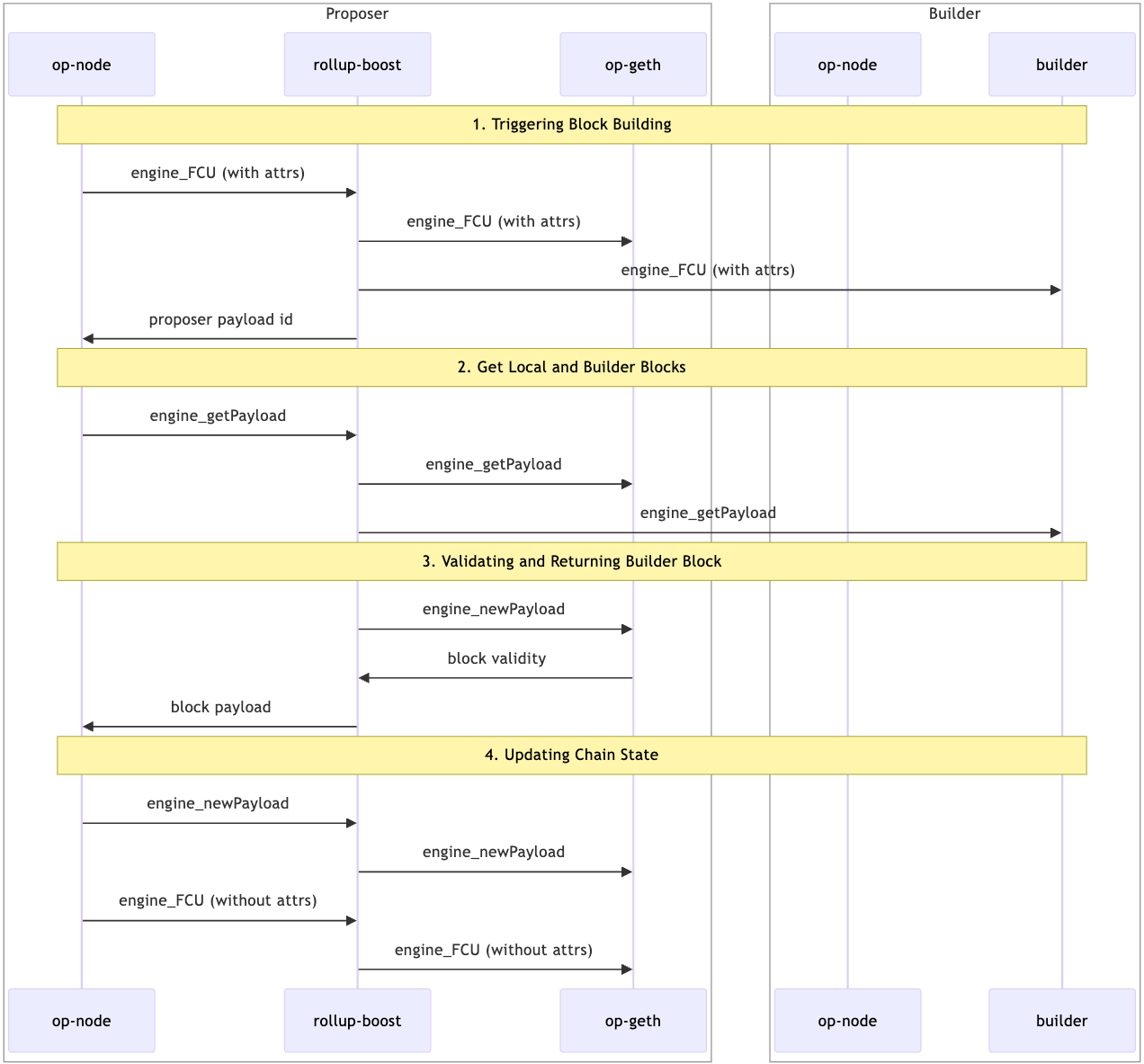
Sequence diagram extracted from Core system workflow of Rollup Boost
Fig. 2: Sequence diagram extracted from Core system workflow of Rollup Boost

The sequence diagram in Fig. 2 is derived from the Rollup Boost GitHub repository. Basically, it serves as a sidecar component for Optimism Stack chains, enabling external block production by introducing a separation between the proposer and builder roles. This design allows for greater flexibility in transaction sequencing and block construction. The core workflow operates as follows:

  1. Initiating Block Building: When the op-node initiates block building, it sends an engine_forkchoiceUpdated (FCU) call with payload attributes to Rollup Boost. Rollup Boost forwards this call to both the local op-geth and the external builder's execution engine.
  2. Fetching Payloads: Upon receiving an engine_getPayload request from the op-node, Rollup Boost concurrently requests payloads from both the local op-geth and the external builder.
  3. Validating and Selecting Payloads: Once the builder's payload is received, Rollup Boost validates it by sending an engine_newPayload call to the local op-geth. If the payload is valid, it is returned to the op-node; otherwise, the fallback payload from the local op-geth is used.
  4. Updating Chain State: The op-node proceeds to update the chain state by sending an engine_newPayload call and another engine_forkchoiceUpdated call without payload attributes to Rollup Boost, which forwards these calls to the local op-geth.

4.3 HTTP Proxy Layer and Multiplexing Logic in proxy.rs

The proxy.rs implements a proxy layer using the Tower middleware framework to intercept and route JSON-RPC HTTP requests based on their method. It is the core component responsible for determining whether a request should be:

  • Sent to the rollup’s local execution engine (l2_client),
  • Sent to the external builder (builder_client),
  • Or sent to both, in a multiplexed fashion.

A. Core Components

  • ProxyLayer - A middleware layer that sets up HttpClient instances for both the local execution engine and the external builder. It wraps a service (inner) and adds health checking via HealthLayer.
  • ProxyService - The service implementation that inspects incoming HTTP JSON-RPC requests, reads the method, and applies routing logic. It clones and spawns requests asynchronously when needed.

B. Routing Logic

The constant string arrays MULTIPLEX_METHODS and FORWARD_REQUESTS determine how each JSON-RPC method is handled:

  • If a method starts with any prefix in MULTIPLEX_METHODS, it may be multiplexed (sent to both builder and L2).
  • If it’s also in FORWARD_REQUESTS, it’s sent to both the builder and L2.
  • Otherwise, it's only handled by the L2 or passed to the inner service.
if MULTIPLEX_METHODS.iter().any(|&m| method.starts_with(m)) {
if FORWARD_REQUESTS.contains(&method.as_str()) {
// Asynchronously forward to builder
// Synchronously forward to L2
} else {
// Handled by the inner server service (proxied to the L2 and/or builder execution engine)
}
} else {
// Directly forward to L2 engine via HttpClient
}

4.4 Main Service Logic: The Role of server.rs

The server.rs file in the Rollup Boost repository serves as the main entry point for the sidecar service, orchestrating interactions between op-node, the local execution client (op-geth), and external block builders. It implements the Engine API methods—engine_forkchoiceUpdated, engine_getPayload, and engine_newPayload—to facilitate modular block production in the OP Stack.

A. Core Responsibilities

The key responsibilities can be summarized in:

  • API Routing and Handling: Defines HTTP endpoints corresponding to Engine API methods, parses incoming requests from the op-node, and routes them to the appropriate handlers.
  • Payload Management: Coordinates the retrieval and validation of block payloads from both the local op-geth and external builders, ensuring selection of the most valid and optimal block.
  • State Coordination: Maintains internal state to track block building processes, map proposer and builder payload IDs, and manage fallback strategies in case of builder failure.

B. Core Functions

  • fork_choice_updated_v3: Processes incoming forkchoiceUpdatedV3 requests, starts the block building process, and manages payload ID mappings.
  • get_payload: Handles payload requests (getPayloadV3 and getPayloadV4) by fetching the built block from the local or external builder (preferred) and returning it to the op-node.
  • new_payload: Forwards incoming block payloads (newPayloadV3 and newPayloadV4) to the local op-geth for validation and returns the result to the caller.

C. Execution Mode

Rollup Boost offers configurable execution modes that determine how it interacts with external block builders. These modes can be adjusted at runtime via the Debug API, allowing operators to tailor the behavior of Rollup Boost without restarting the service.

1. Available Execution Modes - The functions below are called to determine the current execution mode and decide whether to forward the request to the external builder or rely exclusively on local engine.

pub enum ExecutionMode {
Enabled,
DryRun,
Disabled,
Fallback,
}

impl ExecutionMode {
fn is_get_payload_enabled(&self) -> bool {
matches!(self, ExecutionMode::Enabled)
}

fn is_disabled(&self) -> bool {
matches!(self, ExecutionMode::Disabled)
}

fn is_fallback_enabled(&self) -> bool {
matches!(self, ExecutionMode::Fallback)
}
}
  • Enabled: Rollup Boost forwards all Engine API calls to the external builder. This mode fully integrates the builder into the block production process.
  • DryRun: All Engine API calls are sent to the builder, except for engine_getPayload.
  • Disabled: No Engine API calls are sent to the builder.
  • Fallback: Do not use blocks built by the builder. Only blocks from the local op-geth are used.

2. Fallback Mechanism - When operating in Enabled mode, Rollup Boost attempts to retrieve and validate a payload from the external builder. If this payload is deemed invalid, typically by failing the engine_newPayload validation against the local op-geth, Rollup Boost falls back to a locally built payload. This fallback ensures that:

  • The network remains live and responsive even if the external builder is unavailable or returns bad data.
  • The op-node always receives a valid payload, regardless of builder reliability.

4.5 RPC Module (rpc.rs)

The rpc.rs module in Rollup Boost serves as the core interface for forwarding and handling Engine API calls, ensuring seamless integration and coordination among these components.

  • The RpcClient struct defines the client-side interface for interacting with an execution layer node's Engine API in Rollup Boost. It encapsulates the logic required to make authenticated JSON-RPC requests, relying on a JWT-secured auth_client to communicate with the node.
  • The auth_rpc field specifies the URI of the target RPC server, ensuring that the client knows where to route its requests.
  • The payload_source field identifies the origin of the payloads, whether from the local execution engine or an external builder, enabling Rollup Boost to distinguish between different sources during block construction and validation.
pub struct RpcClient {
auth_client: HttpClient<AuthClientService<HttpBackend>>,
auth_rpc: Uri,
payload_source: PayloadSource,
}

The module forwards specific Engine API calls, such as engine_forkchoiceUpdatedV3, engine_getPayloadV3, and engine_newPayloadV3, to both the local execution client and external builders. This multiplexing allows for parallel block building and validation processes.

A. Functionality Overview

The rpc.rs module defines the structure and behavior of the RPC client used by Rollup Boost. It establishes connections to the local execution client and external builders using provided URLs and authentication tokens.

4.6 Summary of Security Implications to Permissioneless Builders

Description
1Do not blindly default to builder block
2Slow down (or even disable) op-geth with extremely large block from builder
3MEV extraction attack like the one performed against Mev-Boost

4.7 Security Implications of Using Permissioneless Builders

The following issues are only applicable to permissionless builders. They arise because rollup-boost does not check the blocks built by builders but relies solely on op-geth to validate these blocks. Furthermore, the system in which Rollup-Boost operates is controlled by Raft consensus, which is not Byzantine resistant.

4.7.1 MEV extraction attack like the one performed against Mev-Boost

File(s): server.rs

Note: A related attack is described in the analysis of the MEV-Boost Relay Attack.

Description: Under the current setup, an attacker does not even need to exploit the system in a sophisticated way to achieve similar outcomes. They can freely insert or reorder transactions as they wish, without resistance or validation barriers.

All transactions are immediately proxied to the block builders. Builders can observe the transactions and (re)order them in any way they want or insert their MEV-extracting transactions. This is not against the protocol and will pass the op-geth validation.

Recommendation(s): We recommend one of the suggestions below to solve it:

  • Allow only permissioned builders;
  • Encrypted mempools (TEE);
  • Maybe not full-blown TEE, but we could only reveal transactions to the builder after they commit to inclusion and ordering of transactions. If they don't respect the commitment, then rollup-boost fallbacks to op-geth block;

4.7.2 Do not blindly default to builder block

File(s): server.rs

Description: The current design blindly defaults to builder-block. This can be problematic as observed in the HA-doc:

> Note that rollup-boost does not currently feature a block selection policy and will optimistically select the builder's block for validation. In the event of a bug in the builder, it is possible valid but undesirable blocks (e.g. empty blocks) are produced. Without a block selection policy, rollup-boost will prefer these blocks over the default execution client. Proper monitoring alerting can help mitigate this but further designs should be explored to introduce safeguards into rollup-boost directly rather than relying on the builder implementation being correct.

Possible scenarios:

  • Proxy fails (for whatever reason) to forward some transaction;
  • Or, in the future, if builder breaks bad and censors transactions;

In both cases the block produced by the builder will be valid, but _bad_.

Recommendation(s): Since we have both builder-block and the L2-EL block, we could at least pick one which has higher gas_used or tx count as the quick solution to some of the problems mentioned above.

4.7.3 Slow down (or even disable) op-geth with extremely large block from builder

File(s): server.rs

Description: A bad block builder can create a huge block, which op-geth will try to validate. If the block is too large, this can significantly slow down the op-geth execution or even cause it to crash altogether.

Here is the codewhere op-geth validates the header, as can be seen on this line, for op-stack chains, validation of the block's GasLimit is skipped.

What an attacker (block builder gone bad) can do is prepare this huge block beforehand. It does not even have to be valid, because the Merkle root is compared only after all execution is done (link) to stall the network or knock out the L2-op-geth altogether.

Recommendation(s): Do not trust the block builder unquestioningly. Since we have a block from op-geth and a builder, we can perform some quick checks, e.g., that the GasLimit produced by the builder is not 100% more, or something similar.

5

Risk Rating Methodology

The risk rating methodology used by Nethermind Security follows the principles established by the OWASP Foundation. The severity of each finding is determined by two factors: Likelihood and Impact.

Likelihood measures how likely the finding is to be uncovered and exploited by an attacker. This factor will be one of the following values:

  1. High: the issue is trivial to exploit and has no specific conditions that need to be met;
  2. Medium: the issue is moderately complex and may have some conditions that need to be met;
  3. Low: the issue is very complex and requires very specific conditions to be met.

When defining the likelihood of a finding, other factors are also considered. These can include but are not limited to motive, opportunity, exploit accessibility, ease of discovery, and ease of exploit.

Impact is a measure of the damage that may be caused if an attacker exploits the finding. This factor will be one of the following values:

  1. High: the issue can cause significant damage, such as loss of funds or the protocol entering an unrecoverable state;
  2. Medium: the issue can cause moderate damage, such as impacts that only affect a small group of users or only a particular part of the protocol;
  3. Low: the issue can cause little to no damage, such as bugs that are easily recoverable or cause unexpected interactions that cause minor inconveniences.

When defining the impact of a finding, other factors are also considered. These can include but are not limited to data and state integrity, loss of availability, financial loss, and reputation damage. After defining the likelihood and impact of an issue, the severity is determined according to the table below.

Impact / LikelihoodLowMediumHigh
HighMediumHighCritical
MediumLowMediumHigh
LowInfo / Best PracticesLowMedium
UndeterminedUndeterminedUndeterminedUndetermined

To address issues that do not fit a High, Medium or Low severity, Nethermind Security also uses three more finding severities: Informational, Best Practices, and Undetermined.

  1. Informational findings do not pose any risk to the application, but they carry some information that the audit team intends to pass to the client formally;
  2. Best Practice findings are used when some piece of code does not conform with smart contract development best practices;
  3. Undetermined findings are used when we cannot predict the impact or likelihood of the issue.

6

Issues

6.1 JWT unencrypted in HTTP connections

FileFix commitTypeStatus
src/client/http.rs—MediumAcknowledged

Connections to the L2 and builder nodes are currently allowed to be through HTTP ( http:// URL) or HTTPS ( https:// URL). Assuming the user sets up a HTTP address for a client, and, given that communication over HTTP is unencrypted, the JSON Web Tokens employed for authentication will be also unencrypted. Though with a validity period of only 60 seconds, in non-local setups (e.g., remote builder), an eavesdropper can easily sniff rollup-boost -> builder packets and gather the JWTs in use. With a hold of these, the eavesdropper can then impersonate the rollup-boost.

Recommendation

Enforce HTTPS-only connections through the setter ConnectionBuilder::https_only(), or warn the user on the use of HTTP in (possible) non-local connections.

Resolution

This mirrors the behavior of all major execution clients, which also allow JSON-RPC over HTTP even when JWT authentication is enabled. Rollup Boost follows the same model as existing Ethereum execution clients. HTTP should only used in trusted or local environments.

6.2 Server listening on all interfaces by default, without authentication

FileFix commitTypeStatus
src/cli.rsPR #209MediumFixed

While configurable by the user, the default 0.0.0.0 makes the server accept incoming connections from any interface, possibly allowing an actor to inject malicious packets which are then signed (using rollup-boost's L2/builder JWT secrets) and forwarded to the L2 and builder nodes. The exposure of this issue is aggravated given that there is no use of an authentication mechanism for incoming messages.

Recommendation

Consider changing the default listening IP to localhost / 127.0.0.1.

6.3 Debug API authentication

FileFix commitTypeStatus
src/debug_api.rs—LowAcknowledged

The debug API allows runtime modification of critical server state ( ExecutionMode) and it doesn't seem to have any application-level authentication, security relies only on port accessibility or firewall.

Recommendation

Implement mandatory authentication.

Resolution

Rollup Boost is not intended to be publicly exposed. Therefore the authentication of the debug API is unnecessary. It's worth mentioning that the same solution is used in op-node's admin RPC.

6.4 JWT tokens timestamped 60 seconds into the future

FileFix commitTypeStatus
src/client/auth.rsPR #211LowFixed

JWT claims used in the engine API are mandated to be valid for +- 60 seconds. However, the current secret_to_bearer_header() function creates JWTs issued 60 seconds into the future. This provides a possible eavesdropper to use the JWT tokens for double their intended duration. Moreover, if the system times of the rollup-boost and the receiving node (L2 or builder) are skewed apart more than the latency between these, the receiving node will block the rollup-boost requests due to a perceived iat being more than 60 seconds into the future.

Recommendation

Remove the addition of the 60 seconds duration from the iat calculation. Use only current time.

6.5 Possible execution_mode inconsistency in get_payload

FileFix commitTypeStatus
server.rsPR #198LowFixed

When get_payload is called the flow is:

  1. Try to get payload from both builder and L2 execution client;

1.1. To decide whether payload should be fetched from external builder, the execution_mode is fetched ( link) 1.2. The way it is fetched is that the mutex is locked and value is copied 2. Once payload is received, process it. 2.1. During payload processing the execution_mode is fetched yet again by locking the mutex and reading the value.

The issue is that between points 1 & 2, some time can pass, and the value of execution_mode might be changed in-between. What can happen is:

  1. execution_mode is set to Enabled, which means the builder will start building the block;
  2. Actor who has access to debug_api can change execution_mode to Disabled;
  3. Builder will return Ok(Some(payload));
  4. Even though execution is set to Disabled we will send the payload from the builder instead from the L2 Execution Client. This is because:;
let (payload, context) = match (builder_payload, l2_payload) {
(Ok(Some(builder)), Ok(l2_payload)) => {
if self.execution_mode().is_fallback_enabled() {
// Default to op-geth's payload
Ok((l2_payload, PayloadSource::L2))
} else {
Ok((builder, PayloadSource::Builder))
}
}
(_, Ok(l2)) => Ok((l2, PayloadSource::L2)),
(_, Err(e)) => Err(e),
}?;

We will end up in a branch: (Ok(Some(builder)), Ok(l2_payload)) but is_fallback_enabled will be false.

Recommendation

Read execution_mode once, at the beginning of get_payload.

6.6 Proxy does not implement rate-limiting

FileFix commitTypeStatus
src/proxy.rs—LowAcknowledged

Rate-limiting helps protect systems from abuse, brute-force attacks, and resource overuse by restricting how often a user can make requests. While the rollup-boost main server implements some rate-limiting through jsonrpsee::Server, the proxy level (at a level above), does not implement so.

Recommendation

Implement a rate-limiting Service, add it to the ProxyService. See for example this.

Resolution

Rollup Boost is not intended to be publicly exposed. Relays or other trusted components should write directly to the proxy service. Chain operators should ensure that rate limiting is enforced elsewhere in the stack.

6.7 Use of sync::Cache in an async context

FileFix commitTypeStatus
src/server.rsPR #219LowFixed

moka provides both sync::Cache and future::Cache, for use in multi-threaded and asynchronous contexts, respectively. While slightly more ( 9%) performant, sync::Cache carries some risk of blocking the async executor threads and therefore, the whole rollup-boost operation. See a more detailed discussion here. As of currently, the employed Cache methods carry a very low risk of temporarily blocking the executor.

Recommendation

Replace moka::sync::Cache by moka::future::Cache. Performance analysis comparing both.

6.8 CI GitHub Action actions-rs unmaintained

FileFix commitTypeStatus
CI filesPR #246InfoFixed

actions-rs/toolchain is a GitHub Action that provides cargo features (build, test, lint, etc.). As of currently, it is unmaintained and archived, and as such, any possible vulnerabilities will not be fixed.

Recommendation

Use cargo as already provided by the CI image ubuntu-latest, or explore other maintained Rust/ cargo GitHub Actions.

6.9 Code inside the is_fallback_enabled() branch may not be reachable

FileFix commitTypeStatus
src/servers.rsPR #198InfoFixed

The function RollupBoostServer.get_payload ensures the execution mode is enabled before attempting to call the builder. If the execution mode disables payload retrieval (e.g., dry-run mode), the builder is not called.

async fn get_payload(
&self,
payload_id: PayloadId,
version: Version,
) -> RpcResult<OpExecutionPayloadEnvelope> {
let l2_client_future = self.l2_client.get_payload(payload_id, version);
let builder_client_future = Box::pin(async move {
let execution_mode = self.execution_mode();
// @audit @audit When fallback mode is enabled, the builder is skipped entirely
if !execution_mode.is_get_payload_enabled() {
info!(message = "dry run mode is enabled, skipping get payload builder call");

// We are in dry run mode, so we do not want to call the builder.
return Err(ErrorObject::owned(
INVALID_REQUEST_CODE,
"Dry run mode is enabled",
None::<String>,
));
}
// ...

After, the function concurrently awaits both the L2 client and the (potential) builder results using tokio::join!. It then matches the outcomes:

  • If both the builder and the L2 client succeed ( Ok results), the function checks if fallback mode is enabled:;
  • If fallback mode ( is_fallback_enabled()) is enabled, the L2 client's payload is chosen.
  • Otherwise, the builder's payload is used.
  • If only the L2 client succeeds while the builder fails or returns no payload, the L2 client's payload is selected instead;
let (l2_payload, builder_payload) = tokio::join!(l2_client_future, builder_client_future);
let (payload, context) = match (builder_payload, l2_payload) {
(Ok(Some(builder)), Ok(l2_payload)) => {
if self.execution_mode().is_fallback_enabled() {
// @audit: This branch will never be executed
// Default to op-geth's payload
Ok((l2_payload, PayloadSource::L2))
} else {
Ok((builder, PayloadSource::Builder))
}
}
(_, Ok(l2)) => Ok((l2, PayloadSource::L2)),
(_, Err(e)) => Err(e),
}?;

Let's say the execution_mode is changed to fallback (i.e., self.execution_mode().is_fallback_enabled() is true) before the get_payload function is invoked. Then, builder_client_future would contains an error meaning that the dry run mode is enabled.

The code inside the is_fallback_enabled() branch is unreachable because if fallback mode is active, the builder is never called in the first place — it is skipped earlier when checking is_get_payload_enabled(). Although this branch is not executed, it does not cause incorrect behavior. The fallback logic properly defaults to selecting the L2 payload when needed.

Recommendation

Review the intended flow to ensure the unused code executes when fallback execution mode is enabled or remove it to reduce its complexity.

6.10 Incoming requests have a large size limit

FileFix commitTypeStatus
src/proxy.rs—InfoFixed

The body of all incoming HTTP requests are first passed through the function http_helpers::read_body() which returns the encoded JSON bytes, if valid in the size range. Internally, this function copies the bytes into a new, returned, buffer. Given that the size limit is currently set at u32::MAX, much larger than expected requests, extra-large (and likely invalid) requests can be used to cause denial-of-service due to the resources needed to copy all of the incoming data. Moreover, the header size of incoming HTTP requests is not set.

Recommendation

Limit the size limit to values closer to expected requests. On the header size, set the maximum header size in order to prevent issues related with oversized headers.

Update from Nethermind Security

The fixing for this issue was identified in PR 221.

6.11 boost_sync flag can cause discrepancies between builder and L2 op-geth

FileFix commitTypeStatus
src/server.rsPR #206InfoFixed

Here is the relevant part for handling FCU requests:

// TODO: Use _is_block_building_call to log the correct message during the async call to builder
let (should_send_to_builder, _is_block_building_call) =
if let Some(attr) = payload_attributes.as_ref() {
// payload attributes are present. It is a FCU call to start block building
// Do not send to builder if no_tx_pool is set, meaning that the CL node wants
// a deterministic block without txs. We let the fallback EL node compute those.
let use_tx_pool = !attr.no_tx_pool.unwrap_or_default();
(use_tx_pool, true)
} else {
// no payload attributes. It is a FCU call to lock the head block
// previously synced with the new_payload_v3 call. Only send to builder if boost_sync is enabled
(self.boost_sync, false)
};

let execution_mode = self.execution_mode();
let trace_id = span.id();
if let Some(payload_id) = l2_response.payload_id {
self.payload_trace_context.store(
payload_id,
fork_choice_state.head_block_hash,
payload_attributes.is_some(),
trace_id,
);
}

if execution_mode.is_disabled() {
debug!(message = "execution mode is disabled, skipping FCU call to builder", "head_block_hash" = %fork_choice_state.head_block_hash);
} else if should_send_to_builder {
let builder_client = self.builder_client.clone();
tokio::spawn(async move {
let _ = builder_client
.fork_choice_updated_v3(fork_choice_state, payload_attributes.clone())
.await;
});
} else {
info!(message = "no payload attributes provided or no_tx_pool is set", "head_block_hash" = %fork_choice_state.head_block_hash);
}

Let's focus on the following scenario:

  1. execution_mode is ExecutionMode::Enabled;
  2. FCU is NOT a building block, but an update head;
  3. If self.boost_sync is disabled, the builder won't receive the update head from the Sequencer; it will have to wait for it from its own L2 node, which can be slow(er);
  4. The request for block building comes before the builder has had time to update the head, which results in the builder not building a block;

A similar argument can be made for the NewPayload call because it depends on self.boost_sync. This may be an even bigger issue because the builder could take too long to receive this new block via P2P (even though it's physically close to the Sequencer).

Recommendation

Maybe remove self.boost_sync altogether. There is no massive benefit in having this flag; conversely, it complicates logic and may lead to bugs.

If this is not acceptable, we recommend that if ExecutionMode::Enabled overpowers self.boost_sync, i.e., even if boost_sync is disabled, we forward requests for ExecutionMode::Enabled. This later is not the best solution because logic is still unnecessarily complex, and issues can arise (albeit highly unlikely) when ExecutionMode is changed and boost_sync is disabled.

6.12 getPayload requests to builder when FCU no_tx_pool is true

FileFix commitTypeStatus
src/server.rsPR #195InfoFixed

FCUs with attributes have a no_tx_pool field. While handling FCUs, the ones with true no_tx_pool are not sent to the builder. The code is presented below:

let (should_send_to_builder, _is_block_building_call) =
if let Some(attr) = payload_attributes.as_ref() {
// payload attributes are present. It is a FCU call to start block building
// Do not send to builder if no_tx_pool is set, meaning that the CL node wants
// a deterministic block without txs. We let the fallback EL node compute those.
let use_tx_pool = !attr.no_tx_pool.unwrap_or_default();
(use_tx_pool, true)
} // ...
}
// ...
else if should_send_to_builder {
let builder_client = self.builder_client.clone();
tokio::spawn(async move {
let _ = builder_client
.fork_choice_updated_v3(fork_choice_state, payload_attributes.clone())
.await;
});
}

However, after this, in get_payload the rollup-boost will attempt to fetch a block from the builder even if no_tx_pool was true, resulting in an unknown payload error from the builder. The code in the get_payload function is presented below:

if !self.payload_trace_context.has_attributes(&payload_id) {
// block builder won't build a block without attributes
info!(message = "no attributes found, skipping get_payload call to builder");
return Ok(None);
}

let builder = self.builder_client.clone();
let payload = builder.get_payload(payload_id, version).await?;

Recommendation

Do not try to fetch payloads from the builder associated with FCUs with attributes and with true no_tx_pool. Leverage/update the use of the trace context accordingly.

6.13 Concurrency in server

FileFix commitTypeStatus
src/server.rs—Best PracticesAcknowledged

Incoming RPC requests are handled by spawning new asynchronous tasks with tokio::spawn; the code doesn't show any mechanism to limit the number of concurrently executed tasks.

Recommendation

Implement limiting, e.g., Semaphore might be a solution.

Resolution

There are instances where op-node will send a quick succession of FCUs following derivation which requires that no rate limiting is in place. Further, Tokio is setup by default with number of background workers equal to number of CPU cores and tokio tasks are efficient to spawn. Relays or other trusted components should write directly to the proxy service. Chain operators should ensure that rate limiting is enforced elsewhere in the stack. We believe this finding should not be in the report.

6.14 Different conditions for cache insertion/eviction

FileFix commitTypeStatus
src/server.rsPR #220Best PracticesFixed

While payload IDs are stored in the cache on every FCU call, they are only removed in new-payload calls when boost_sync is enabled and the current execution mode is not Disabled. If the second set of conditions is not fulfilled, then the cache is only evicted upon its size limit being reached (100 entries).

Recommendation

To avoid an unnecessary large cache, only keep track of payload IDs for FCUs which are sent to the builder.

6.15 Do not clone payload in server|fcu_v3

FileFix commitTypeStatus
server.rsPR #210Best PracticesFixed

The cloned code in the server::fork_choice_updated_v3 function ( link/src/server.rs#L302)) is not needed:

let _ = builder_client
.fork_choice_updated_v3(fork_choice_state, payload_attributes.clone())
.await;

Recommendation

We suggest not cloning the payload_attributes:

- let _ = builder_client
- .fork_choice_updated_v3(fork_choice_state, payload_attributes.clone())
- .await;
+ let _ = builder_client
+ .fork_choice_updated_v3(fork_choice_state, payload_attributes)
+ .await;

6.16 Silent failures of tokio::spawn

FileFix commitTypeStatus
server.rs—Best PracticesAcknowledged

In fork_choice_updated_v3 and new_payload functions, requests to the builder are dispatched asynchronously using tokio:: spawn to ensure quick server responses. However, there are some concerns:

In the new_payload function, the result of the spawned task is explicitly ignored:

tokio::spawn(async move {
let _ = builder.new_payload(new_payload_clone).await;
});

Recommendation

Failures in the spawned tasks should be logged using tracing or captured through metrics to aid in debugging and monitoring.

Resolution

The underlying methods (new_payload_v3 and new_payload_v4) are instrumented with tracing and they are dispatched early.

6.17 Using expect and unwrap in the code

FileFix commitTypeStatus
src/client/auth.rs
src/client/http.rs
PR #243Best PracticesFixed

There are unchecked unwrap and expect calls in few non-test paths which can trigger the process to panic! if it fails to unwrap.

Recommendation

Replace unwrap/expect with proper error handling

Resolution

Fixed in PR 243. This PR resolved most unwraps and expects in production code. Some unwraps remain in test code. And some expects remain in prod code - but are limited to service initialization or cases where the panic case is guarded against.

6.18 CI use cargo deny

FileFix commitTypeStatus
.PR #249Best PracticesFixed

cargo deny is a dependency linter, which analyzes dependencies security advisories, bans, licenses, and sources. If added to CI, such analysis will occur when the respective pipeline is triggered, enabling an alert, if there are any issues with a newly added dependency, or if any new issues popped-up with existing dependencies. There is no apparent dependency scanning or vulnerability management visible in the repository.

Recommendation

Add cargo deny or any other dependency vulnerability scanner to a CI pipeline.

6.19 Do not clone payload in rpc|new_payload_v3

FileFix commitTypeStatus
rpc.rsPR #210Best PracticesFixed

In rpc.rs|new_payload_v3, the payload is unnecessarily cloned, just to log hash. The average block size on, e.g., Base (which is another op-stack derived chain), is 65KB, while max was 500KB ( source), this could easily be avoided.

Recommendation

We recommend to apply the following change:

- let execution_payload = ExecutionPayload::from(payload.clone());
- let block_hash = execution_payload.block_hash();
+ // Note: this can be hidden behind a function call to improve the readeability
+ let block_hash = payload.payload_inner.payload_inner.block_hash;

Note: Similarly for cloning the new_payload here.

6.20 Logic of forwarding requests should be improved

FileFix commitTypeStatus
proxy.rsPR #221
PR #302
Best PracticesAcknowledged

All requests which are to be forwarded should not be treated equally. Specifically, there are eth_ and miner_ requests. If for some reason miner_ succeeds on the L2-EL but fails on the builder (or vice versa), it can result in discrepancy with critical information for consensus, such as GasPrice and GasLimit.

This can lead to a block created by the builder with a higher gas limit than what L2-EL expects. As a result, the L2-EL will mark this block invalid and potentially flag all the future builder blocks as invalid invalid as well, effectively disabling builder functionality.

Recommendation

Increase the robustness of the forwarding mechanism. The miner_ should be forwarder to the builder only if the call to EL-L2 succeeds. If the builder fails to process the request, the failure should be logged. In addition, the system should set the execution_status to Disabled to prevent further issues.

Resolution

During the audit, issue 7.20 was raised regarding how we forwarded requests in proxy.rs. At the time, all forwarded methods were handled the same way. Nethermind flagged that this could cause an issue if miner_ methods like miner_setGasLimit succeeded on the L2 execution client but failed on the builder, it could lead to inconsistent blocks constraints.

We addressed this in PR 221 by updating the forwarding logic to include retries for miner_setMaxDASize. If the builder request fails, the updated logic set execution_mode to Disabled and continually retried the request. However, this PR introduced a memory leak. The retry logic for miner_setMaxDASize would clone the request and sleep 200ms between attempts. In cases where the call was timing out, this led to a large buildup of in-flight retries and unbounded memory growth.

We fixed this in PR 302 which removes the retry logic for miner_setMaxDASize entirely. Instead, these calls are now treated like any other forwarded request. This is sufficient because op-batcher sends a miner_setMaxDASize update every 10 seconds regardless of the current throttle state, so the builder receives updates regularly even if a single call fails, removing the need for retry logic in the proxy.

Since this fix landed, Flashblocks logic has been added to the codebase and the project has been restructured into a Cargo workspace. The logic previously in scope for the audit is now under crates/rollup-boost.

7

Documentation Evaluation

Software documentation refers to the written or visual information that describes the functionality, architecture, design, and implementation of software. It provides a comprehensive overview of the software system and helps users, developers, and stakeholders understand how the software works, how to use it, and how to maintain it. Software documentation can take different forms, such as user manuals, system manuals, technical specifications, requirements documents, design documents, and code comments. Software documentation is critical in software development, enabling effective communication between developers, testers, users, and other stakeholders. It helps to ensure that everyone involved in the development process has a shared understanding of the software system and its functionality. Moreover, software documentation can improve software maintenance by providing a clear and complete understanding of the software system, making it easier for developers to maintain, modify, and update the software over time. Smart contracts can use various types of software documentation. Some of the most common types include:

  • Technical whitepaper: A technical whitepaper is a comprehensive document describing the smart contract’s design and technical details. It includes information about the purpose of the contract, its architecture, its components, and how they interact with each other;
  • User manual: A user manual is a document that provides information about how to use the smart contract. It includes step-by-step instructions on how to perform various tasks and explains the different features and functionalities of the contract;
  • Code documentation: Code documentation is a document that provides details about the code of the smart contract. It includes information about the functions, variables, and classes used in the code, as well as explanations of how they work;
  • API documentation: API documentation is a document that provides information about the API (Application Programming Interface) of the smart contract. It includes details about the methods, parameters, and responses that can be used to interact with the contract;
  • Testing documentation: Testing documentation is a document that provides information about how the smart contract was tested. It includes details about the test cases that were used, the results of the tests, and any issues that were identified during testing;
  • Audit documentation: Audit documentation includes reports, notes, and other materials related to the security audit of the smart contract. This type of documentation is critical in ensuring that the smart contract is secure and free from vulnerabilities.

These types of documentation are essential for smart contract development and maintenance. They help ensure that the contract is properly designed, implemented, and tested, and they provide a reference for developers who need to modify or maintain the contract in the future.

8

Remarks & Test Suite

The documentation for the Rollup Boost was provided in the folder docs with a high-level description. Moreover, the Rollup Boost team addressed all questions and concerns raised by the Nethermind Security team, providing valuable insights and a comprehensive understanding of the project's technical aspects.

8.1 The code for get_payload is not easy to reason about

Code as documentation is crucial for ensuring readability and reducing the effort for program comprehension, especially in complex systems, where implicit logic can easily lead to misunderstandings or errors. The get_payload function in server.rs exemplifies this: the control flow is hard to trace, which can lead to bugs in the future. By not making the intent and decision-making process explicit in the code, future contributors may misinterpret the expected behavior. Some examples are listed below:

  • Inconsistencies in how execution_mode is handled (see issue);
  • Code inside the is_fallback_enabled() branch may not be reachable in certain scenarios (see issue), potentially resulting in future defects.

Recommendation(s): Refactor the get_payload function so that there is a clear difference in flow when a block is expected from the builder vs. when it is not. A proposed refactor is attached below, which improves the code by:

  1. Ensuring execution_state is read once, preventing inconsistencies as described above;
  2. Making the control flow more explicit: a block is fetched from the builder only when ExecutionState::Enabled;
  3. Small performance gain, as we do not have to create a future and call join unnecessarily.

The diff below illustrates a suggestion of refactoring:

src/server.rs | 81 +++++++++++++++++++++++++--------------------------
1 file changed, 39 insertions(+), 42 deletions(-)

diff --git a/src/server.rs b/src/server.rs
index 59d83cd..bfdc83b 100644
--- a/src/server.rs
+++ b/src/server.rs
@@ -117,6 +117,7 @@ impl ExecutionMode {
matches!(self, ExecutionMode::Disabled)
}

+ #[allow(unused)]
fn is_fallback_enabled(&self) -> bool {
matches!(self, ExecutionMode::Fallback)
}
@@ -536,26 +537,48 @@ impl RollupBoostServer {
}
Ok(self.l2_client.new_payload(new_payload).await?)
}
-
async fn get_payload(
&self,
payload_id: PayloadId,
version: Version,
) -> RpcResult<OpExecutionPayloadEnvelope> {
+ let (payload, context) = if self.execution_mode().is_get_payload_enabled() {
+ self.get_payload_from_builder(payload_id, version).await?
+ } else {
+ info!(message = "builder mode not enabled, skipping get payload builder call");
+ let payload = self.l2_client.get_payload(payload_id, version).await?;
+ (payload, PayloadSource::L2)
+ };
+
+ tracing::Span::current().record("payload_source", context.to_string());
+ counter!("rpc.blocks_created", "source" => context.to_string()).increment(1);
+
+ let inner_payload = ExecutionPayload::from(payload.clone());
+ let block_hash = inner_payload.block_hash();
+ let block_number = inner_payload.block_number();
+
+ info!(
+ message = "returning block",
+ "hash" = %block_hash,
+ "number" = %block_number,
+ %context,
+ %payload_id,
+ );
+ Ok(payload)
+ }
+
+ async fn get_payload_from_builder(
+ &self,
+ payload_id: PayloadId,
+ version: Version,
+ ) -> RpcResult<(OpExecutionPayloadEnvelope, PayloadSource)> {
let l2_client_future = self.l2_client.get_payload(payload_id, version);
let builder_client_future = Box::pin(async move {
@@ -563,7 +586,7 @@ impl RollupBoostServer {
if !self.payload_trace_context.has_attributes(&payload_id) {
info!(message = "no attributes found, skipping get_payload call to builder");
- return Ok(None);
+ return Ok::<Option<OpExecutionPayloadEnvelope>, ErrorObject>(None);
}

let builder = self.builder_client.clone();
@@ -582,38 +605,12 @@ impl RollupBoostServer {
         let (l2_payload, builder_payload) = tokio::join!(l2_client_future, builder_client_future);
let (payload, context) = match (builder_payload, l2_payload) {
- (Ok(Some(builder)), Ok(l2_payload)) => {
- if self.execution_mode().is_fallback_enabled() {
- Ok((l2_payload, PayloadSource::L2))
- } else {
- Ok((builder, PayloadSource::Builder))
- }
- }
+ (Ok(Some(builder)), _) => Ok((builder, PayloadSource::Builder)),
(_, Ok(l2)) => Ok((l2, PayloadSource::L2)),
(_, Err(e)) => Err(e),
}?;

- tracing::Span::current().record("payload_source", context.to_string());
- counter!("rpc.blocks_created", "source" => context.to_string()).increment(1);
-
- let inner_payload = ExecutionPayload::from(payload.clone());
- let block_hash = inner_payload.block_hash();
- let block_number = inner_payload.block_number();
-
- info!(
- message = "returning block",
- "hash" = %block_hash,
- "number" = %block_number,
- %context,
- %payload_id,
- );
- Ok(payload)
+ Ok((payload, context))
}
}

Table 3 presents the code coverage with overall percentages exceeding 79% in three categories: function, line, and region metrics. However, branch coverage stands out as notably lower, achieving only 63.64% overall. This discrepancy suggests that while most functions and lines of code are executed during testing, many conditional branches are not fully explored. This can leave important edge cases and alternative code paths untested, potentially hiding bugs that only manifest under specific conditions. Improving branch coverage should be prioritized to enhance the robustness and reliability of the test suite, where coverage is especially low.

FilenameFunction CoverageLine CoverageRegion CoverageBranch Coverage
bin/main.rs100.00% (2/2)100.00% (7/7)100.00% (2/2)– (0/0)
cli.rs17.65% (3/17)60.91% (67/110)42.20% (46/109)50.00% (6/12)
client/auth.rs100.00% (6/6)100.00% (33/33)100.00% (6/6)– (0/0)
client/http.rs100.00% (3/3)100.00% (27/27)87.50% (7/8)– (0/0)
client/rpc.rs92.00% (23/25)92.73% (153/165)88.89% (72/81)50.00% (2/4)
debug_api.rs100.00% (14/14)100.00% (123/123)90.16% (55/61)– (0/0)
health.rs100.00% (5/5)100.00% (15/15)100.00% (8/8)100.00% (2/2)
metrics.rs50.00% (3/6)40.91% (18/44)38.89% (14/36)25.00% (1/4)
proxy.rs94.34% (50/53)96.32% (707/734)86.76% (249/287)62.50% (5/8)
server.rs95.38% (62/65)91.77% (591/644)85.59% (285/333)76.67% (23/30)
tracing.rs71.43% (5/7)72.50% (87/120)65.12% (28/43)50.00% (3/6)
Totals86.70% (176/203)90.41% (1828/2022)79.26% (772/974)63.64% (42/66)

Table 3: Test Coverage Summary

The code has a good level of line coverage, but some branches are not executed in tests. There are several scenarios that should be tested in the application:

  • client/rpc.rs: The client does not validate or handle the case where new_payload_v4 returns an invalid status, leaving the RpcClientError::InvalidPayload path untested.
  • client/rpc.rs: The success path for new_payload_v4 is not exercised, which risks silently breaking correct handling of valid responses.
  • client/rpc.rs: The handling of get_payload_v4 receiving a V3 payload is untested; if this happens, the client should emit a version mismatch error.
  • proxy.rs: The proxy does not have coverage for cases where the HTTP body is unreadable, e.g., truncated or disconnected payloads, which should trigger JSON-RPC error -32700.
  • proxy.rs: The proxy does not validate or test scenarios where the HTTP body contains syntactically invalid JSON, which should result in a parse error (-32700).
  • proxy.rs: Valid JSON-RPC requests with unknown method names are not tested and may return incorrect or missing errors instead of the required -32601 error.

Recommendation(s): Consider implementing tests for the scenarios presented above.

Test suite
19Tests passed0Failed

The complete test output is in the full report.

As auditors, we recommend that any changes or updates made to the audited codebase undergo a re-audit or security review to address potential vulnerabilities or risks introduced by the modifications. By conducting a re-audit or security review of the modified codebase, you can significantly enhance the overall security of your system and reduce the likelihood of exploitation. However, we do not possess the authority or right to impose obligations or restrictions on our clients regarding codebase updates, modifications, or subsequent audits. Accordingly, the decision to seek a re-audit or security review lies solely with you.

This report is based on the scope of materials and documentation provided by you to Nethermind in order that Nethermind could conduct the security review outlined in 1. Executive Summary and 2. Audited Files. The results set out in this report may not be complete nor inclusive of all vulnerabilities. Nethermind has provided the review and this report on an as-is, where-is, and as-available basis. You agree that your access and/or use, including but not limited to any associated services, products, protocols, platforms, content, and materials, will be at your sole risk. Blockchain technology remains under development and is subject to unknown risks and flaws. The review does not extend to the compiler layer, or any other areas beyond the programming language, or other programming aspects that could present security risks. This report does not indicate the endorsement of any particular project or team, nor guarantee its security. No third party should rely on this report in any way, including for the purpose of making any decisions to buy or sell a product, service or any other asset. To the fullest extent permitted by law, Nethermind disclaims any liability in connection with this report, its content, and any related services and products and your use thereof, including, without limitation, the implied warranties of merchantability, fitness for a particular purpose, and non-infringement. Nethermind does not warrant, endorse, guarantee, or assume responsibility for any product or service advertised or offered by a third party through the product, any open source or third-party software, code, libraries, materials, or information linked to, called by, referenced by or accessible through the report, its content, and the related services and products, any hyperlinked websites, any websites or mobile applications appearing on any advertising, and Nethermind will not be a party to or in any way be responsible for monitoring any transaction between you and any third-party providers of products or services. As with the purchase or use of a product or service through any medium or in any environment, you should use your best judgment and exercise caution where appropriate. FOR AVOIDANCE OF DOUBT, THE REPORT, ITS CONTENT, ACCESS, AND/OR USAGE THEREOF, INCLUDING ANY ASSOCIATED SERVICES OR MATERIALS, SHALL NOT BE CONSIDERED OR RELIED UPON AS ANY FORM OF FINANCIAL, INVESTMENT, TAX, LEGAL, REGULATORY, OR OTHER ADVICE.