In March 2026, Nethermind's CI ran 2,468,203 minutes of testing. A year earlier it was 246,253, now more than 10x higher. AI tooling has increased contribution velocity across the ecosystem and the volume of code reaching our repository with it. Some teams have responded by closing their source code. Here's what we've built instead.
The numbers
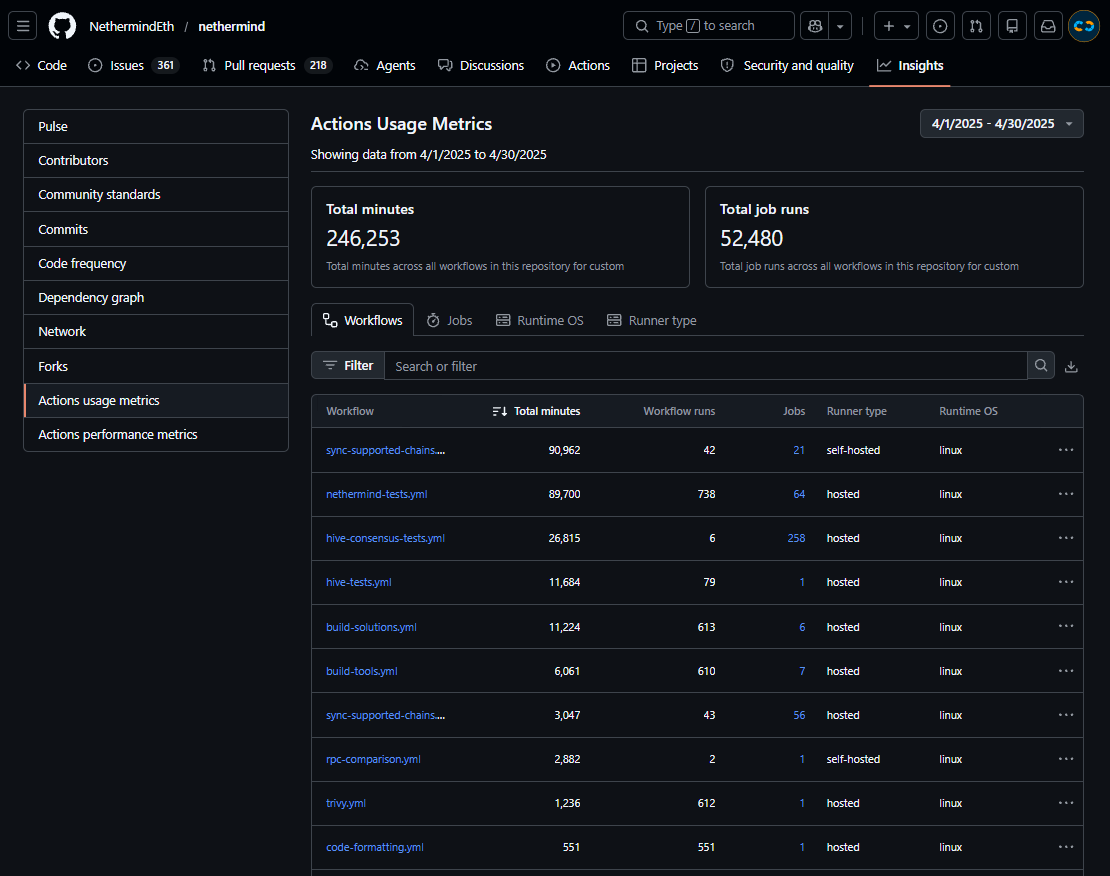
In April 2025, Nethermind's CI ran 246,253 minutes of testing across 52,480 job runs.
Figure 1: Actions Usage Metrics - April 2025
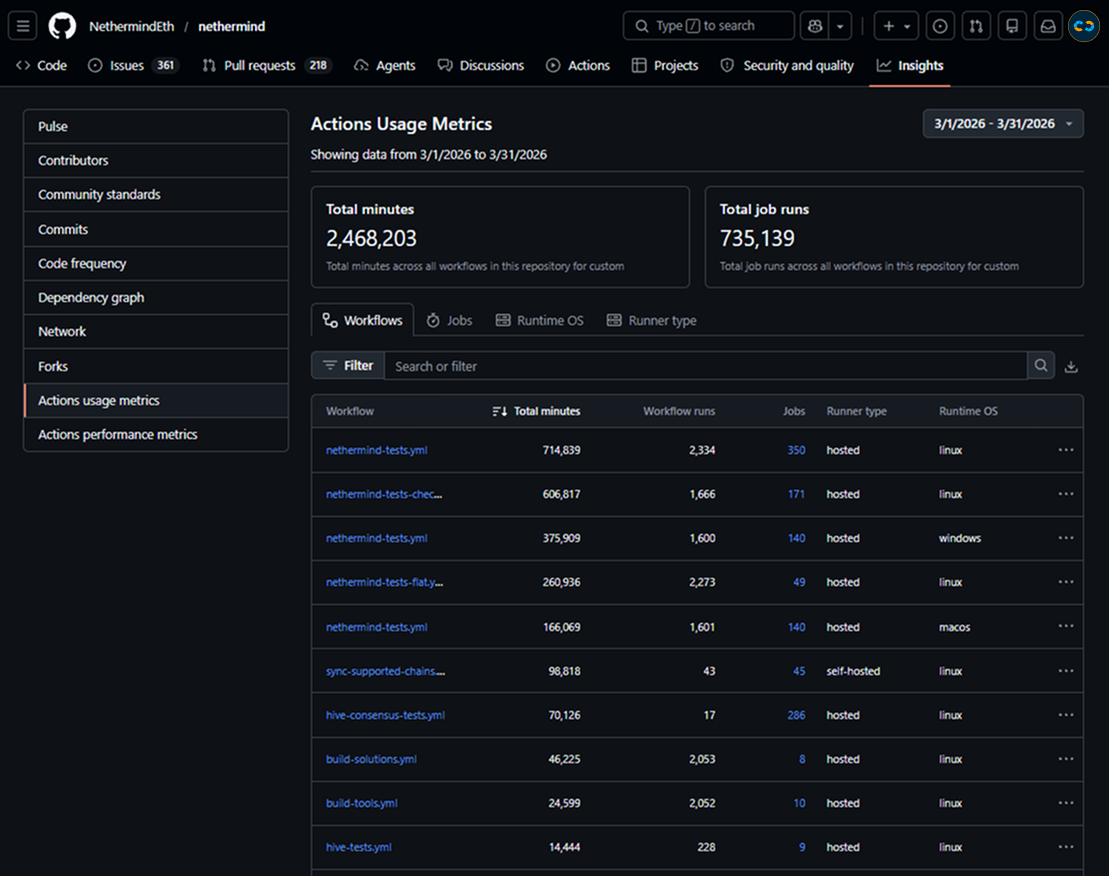
In March 2026, Nethermind ran 2,468,204 minutes of testing and 735,139 job runs, resulting in roughly a 10x increase in compute time dedicated to validation, year-over-year. To put that in perspective, April 2025 represented 171 days of continuous compute in a single month. March 2026 was 1,714.
Figure 2: Actions Usage Metrics - March 2026
At the per-commit level: on January 1, 2026, a change entering our main branch triggered roughly 162,783 test executions. By April 1, that number was approximately 1,427,000, around 8.8x more, with 32% more unique tests in the suite.
What grew was not just volume but coverage: execution, consensus, state transition logic, trie and database correctness, JSON-RPC, networking, synchronization, transaction pool behavior, plugin integrations, and Ethereum reference and spec suites for blockchain, VM, transaction, difficulty, SSZ, RLP, and PoW behavior. Every PR now runs in checked mode, a release-speed build with Debug.Assert enabled, across Intel and ARM, Windows, macOS, and Linux, with hardware acceleration on and off. A change must also show it can still sync before it passes the gate.
Figure 3: Commits over time, NethermindEth/nethermind
Per-release, the numbers go further. A hotfix typically accumulates 3 to 4 million test executions before it ships. A patch release lands between 57 and 81 million. A minor release is closer to 595 million. The current upcoming minor has already passed 841 million.
None of this is automation scaling on its own. We have dedicated QA engineers focused on this work full time: expanding coverage, adding new validation checks, improving workflows, catching regressions earlier. They use AI tools too, but as a way to amplify their judgment, not replace it. As more code is produced more quickly, having people specifically focused on validation matters more, not less.
The argument for staying open
There's a case being made right now that AI changes the calculus on open source. The reasoning goes: if attackers can scan, map, and exploit your code at near-zero cost using AI, transparency becomes a liability. Close the code, protect the customers.
We have a different approach.
Security through obscurity has always been a weak foundation. Closing source doesn't eliminate vulnerabilities, it just means fewer eyes are finding them before attackers do. For infrastructure software, the assurance that comes from public auditability is part of the value proposition. Remove that and you're asking users to trust you on faith.
The better response to AI-assisted attacks is AI-assisted defence. Use the same tools to find issues before they become exploitable. Cover more edge cases. Add more checks. Build the validation layer that makes your code harder to attack, not just harder to read.
That's what these numbers represent: commit frequency has grown alongside test volume. AI tooling has increased contribution velocity across the ecosystem, and the volume of code reaching our repository with it. The response wasn't to slow down or close up. It was to build a validation layer that scales faster than the rate of change.
What This Means for Institutional Users
Execution clients sit at the base of Ethereum's infrastructure. A consensus bug, a memory regression, or an edge case that surfaces only under a specific hardware and OS configuration isn't a developer inconvenience. In the wrong place, it becomes a costly operational failure.
Institutional users need to know that a team can maintain correctness as contribution volume rises, complexity increases, and AI-assisted development speeds up the flow of change. That is a harder standard to meet than it used to be, and it requires deliberate investment.
AI, Assurance, and the New Validation Layer
We use AI tools across engineering. They help expand test coverage, identify edge cases, accelerate backlog items that might otherwise sit untouched, build benchmarks, support security review, and help engineers iterate faster on new ideas. In some cases, they also assist with production code. We do not treat that as unusual. It is part of how modern software is increasingly built.
In critical infrastructure, what matters is not whether a change began with a human or a model, but whether it survives the validation layer around it. Every contribution to Nethermind, internal, external, human-written, or AI-assisted, passes through the same review process: checked-mode runs, cross-platform CI, benchmark workflows, and release-scale test accumulation before anything ships.
That distinction matters because open source is now under pressure from both sides. It is easier than ever to contribute to important software, and easier than ever to analyse, stress, and attack it from every angle. Smaller projects cannot assume the kind of defence in depth available to large companies. They need a development process that treats validation as a first-class capability. In our view, that is becoming one of the defining engineering problems of the AI era.
We also do not see testing as the end of the story. Nethermind works at the intersection of critical infrastructure, formal methods, and AI systems. Alongside deeper testing and broader CI, we are investing in stronger assurance methods over time, including formal verification for the parts of the stack where correctness matters most. As software becomes easier to generate and easier to attack, the ability to show that systems do exactly what developers intend, and only that, will become increasingly important.
AI is making it easier to contribute and easier to attack. Riding that wave means building better defences. That is the job. Trust in critical infrastructure is earned, and these are some of the numbers behind ours.





.png)