Ethereum’s rapid transformation into a modular, interoperable platform is fundamentally redefining the trust model in blockchain. As rollups and off-chain solutions move execution away from the mainnet, Ethereum increasingly serves as a neutral settlement layer, recording only cryptographic execution proofs of VM state transitions.
This trajectory, while unlocking scalability and cross-domain composability, amplifies both the complexity and stakes of platform security. In this context, formal verification, the use of computer-checkable mathematical proofs to ensure the correctness of code and protocols, emerges as an important requirement for the security of Ethereum's main network.
From Ethereum Transactions to Proofs: Why Formal Verification is Essential
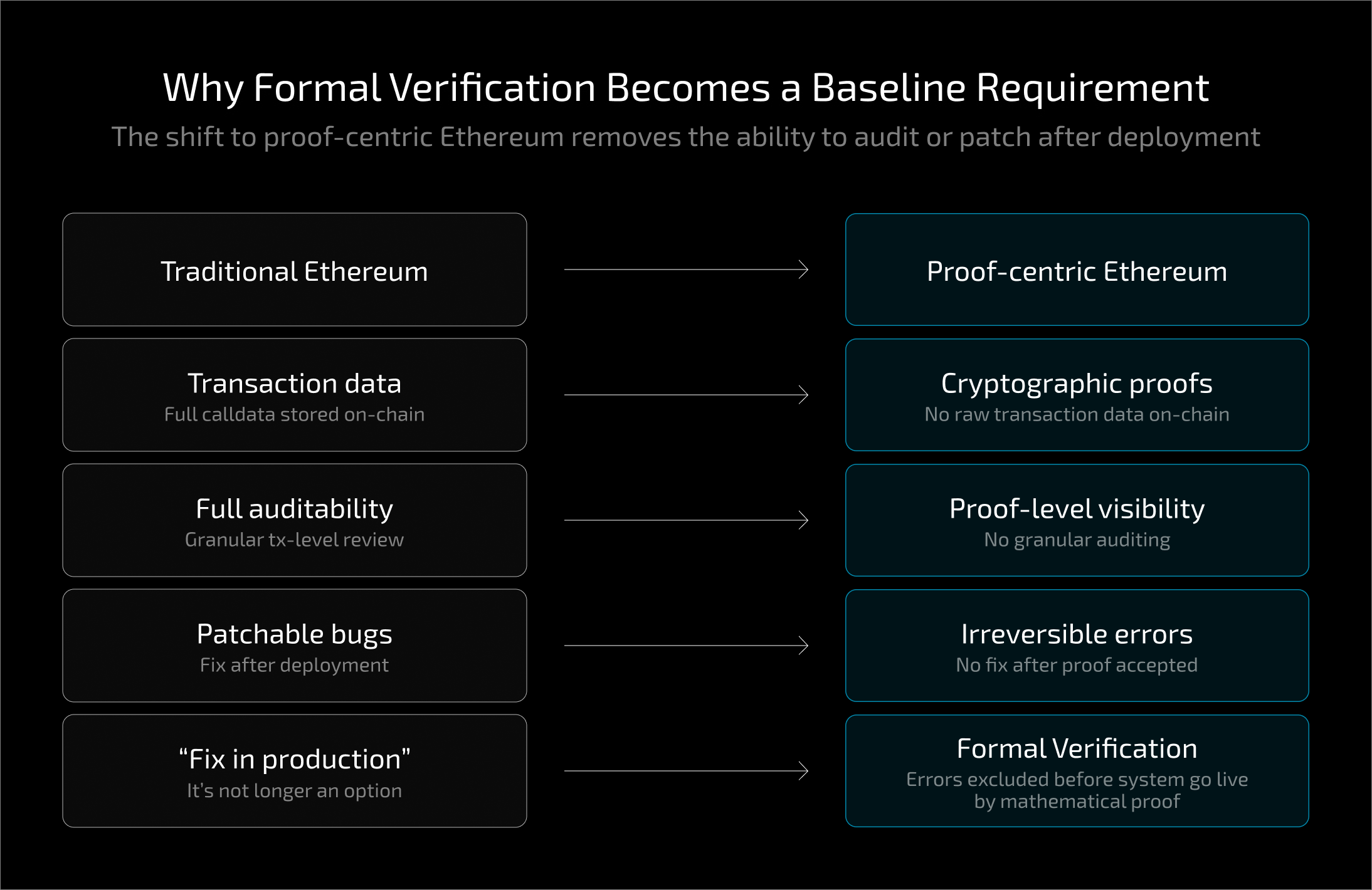
With the adoption of rollup-centric scaling, Ethereum is moving toward a future in which most transactions are verified via succinct validity proofs stored on-chain. This shift brings significant performance and data-minimization benefits, but it also drastically reduces the visibility and auditability of on-chain operations. When validating state transitions relies on cryptographic proofs, granular transaction-level auditing can become infeasible.
Worse, bugs in these cryptographic systems can lead to irreversible state loss and may be impossible to detect. Once a state transition proof is accepted, its correctness is presumed final, and any bug or exploit that passes the verification layer becomes effectively irreversible up to social consensus. The risks become even more pronounced as interoperable rollups, bridges, and standardized data models amplify the potential impact of bugs, potentially allowing errors to propagate across domains undetected.
This architectural evolution makes formal verification not just desirable but essential. The familiar “fix in production” paradigm becomes obsolete in a world where code cannot be analyzed or patched after deployment. Instead, errors must be formally excluded before systems go live. As the complexity of cross-chain, multi-domain applications increases, even minor inconsistencies in business logic or data standards can cause systemic failures that affect entire sectors.
Enterprises and institutions, meanwhile, require strong evidence that the systems managing their assets or compliance obligations cannot fail due to software bugs or logic errors. The challenge is further intensified by the limitations of traditional audits and monitoring in this new environment, where only validity proofs, rather than full data, are available for review.
Figure 1: The shift from traditional to proof-centric Ethereum removes the ability to audit or patch after deployment, making formal verification a baseline requirement rather than a best practice.
In response to these realities, the Ethereum ecosystem has seen significant advances in research and engineering dedicated to bringing formal verification into smart contract development, rollup design, and interoperability protocols. While individual teams have pioneered open-source tools and methods to verify everything from business logic to cryptographic circuit design, these advances are gradually setting new benchmarks for security and reliability across public blockchains.
Innovation from the Ethereum Foundation and Ecosystem
The Ethereum Foundation has intensified its commitment to formal verification as a foundational pillar of its transition toward a fully SNARK-verifiable execution environment. As outlined in the Ethereum Foundation's Strawmap roadmap, this includes targeting the progressive removal of raw transaction data from the chain in favor of cryptographic proofs, accelerating the shift toward more efficient proof generation enabled by zKVMs.
In this environment, formal verification becomes not only a desirable security practice but an operational necessity: the correctness of constraint systems, the soundness of circuits, and the robustness of cryptographic assumptions directly determine the safety of economic activity within the protocol and the operational continuity of applications on Ethereum. Ensuring that zkVMs can deliver client-side and real-time proving performance without compromising correctness supports the vision of a “seamless “ use of Ethereum. At the same time, it requires a disciplined, standardized approach to verification, particularly as businesses and institutions begin delegating authorisation and settlement functions to client-side proof systems.
To support this transition, the Ethereum Foundation has established a coordinated effort to harmonise formal verification practices across the ecosystem. This includes the creation of emerging standards for the formal verification of zkVM constraint systems, exemplified by Nethermind’s recent collaboration with Succinct to formally verify SP1 in Lean, extracting circuit constraints, writing precise formal specifications, and proving the correctness of ALU chips against a formal definition of 32-bit wrap-around addition, with full RISC-V specification coverage as the long-term target.
In parallel, the Ethereum Foundation is defining minimum cryptographic safety requirements, ensuring that the primitives used in SNARK systems uphold appropriate levels of security, even against post-quantum adversaries. These initiatives are complemented by targeted funding for verification-focused research and tooling, most notably the ArkLib project, which aims to formally verify the cryptographic protocols underpinning SNARK generation and verification. Nethermind’s Formal Verification team has contributed directly to ArkLib, establishing reusable formal models and soundness blueprints for the proof systems that underpin modern zero-knowledge infrastructure.
This strategic focus on formal verification is further reinforced by the Ethereum Foundation’s long-standing commitment to client diversity and multi-implementation safety. By maintaining several independently engineered execution clients, each subject to its own verification models, Ethereum preserves a structural buffer against systemic failures, even as the network experiments with increasingly advanced verification architectures. This is also balanced by a temporary retention of on-chain transaction data during this transition period, as it provides an additional safeguard, ensuring that verifiers, auditors, and clients retain the capacity to audit state transitions and validate proof correctness while the SNARK-first paradigm matures. Together, these efforts establish a credibility framework for Ethereum’s evolution toward a high-assurance, cryptographically verified settlement layer suitable for institutional, governmental, and cross-border digital infrastructure.
The protocol-level work underway at the Ethereum Foundation and across the ecosystem establishes the cryptographic foundation. But for enterprises and institutions, the security of the underlying proof systems is only half the equation. The other half is data: specifically, whether the standards governing how assets, credentials, and compliance obligations are represented on-chain can be formally verified to the same level of rigour. Without that, the guarantees that formal verification provides at the protocol layer do not automatically extend to the applications built on top of it.
The Importance of Data Standardization for Enterprise and Institutional Mass Adoption
As enterprise adoption accelerates, standardized data formats such as token models, verifiable credentials, and regulatory reporting schemas are becoming central to composability and compliance. However, the very process of standardization also introduces new verification requirements. Without direct, on-chain data access, only formal verification of conformance with appropriate formal specifications can provide enterprises with the level of assurance they require when bridging permissioned and permissionless networks. Data interoperability, a core promise of blockchain, thus depends on the ability to formally guarantee both technical and semantic correctness at every layer.
As blockchain networks proliferate across sectors and borders, the role of recognized standardization bodies such as the International Organization for Standardization (ISO), the European Telecommunications Standards Institute (ETSI), and the European Committee for Electrotechnical Standardization (CENELEC) is increasingly engaged by public authorities to develop rigorous, machine-verifiable standards for blockchain data formats and compliance processes.
ISO/TC 307 Working Group 4 (WG4), which focuses on data governance, privacy, and data minimization in blockchain systems, is one concrete example of this work. Eugenio Reggianini, an accredited expert in ISO TC 307 and CEN JTC 19 (UNI — Italy), argues that formal verification could provide the technical foundation for standardizing correct data processing across permissioned and permissionless networks, a precondition for cross-border institutional adoption.
Conclusion
Ethereum's shift toward a proof-centric architecture permanently changes the security calculus. When post-hoc remediation is off the table and cryptographic proofs substitute for on-chain auditability, formal verification moves from best practice to baseline requirement. The work underway across zkVM constraint systems, open standards, and international standardization bodies determines whether this infrastructure is fit for institutional and public-sector deployment at scale.
Author
About the Authors
Eugenio Reggianini is an independent Business and Product Development Manager, Former Head of Growth at the European Blockchain Association, ISO TC 307 and CEN JTC 19 Accredited Expert (UNI - Italy) and a contributor to the Decentralized Identity Foundation. He focuses on the intersection of blockchain infrastructure, institutional adoption, and EU regulatory frameworks.
Julian Sutherland is the Head of Formal Verification at Nethermind, leading a team of researchers and engineers building machine-checked proofs for the ecosystem’s most critical zkVM systems. He holds a PhD and has published in world-class conferences and journals in program analysis, type theory, and mathematical logic.
get in touch
Work with Nethermind Security
Nethermind Security audits the protocols securing billions on-chain. If you are shipping something that needs to hold up, let's talk.