Updated November 2026. Flat DB shipped in Nethermind 2.0.0. Status, archive support, and performance figures have changed since this post published on 7 April.
Introduction
Ethereum state is large, structurally complex, and grows with every block. How a client stores and retrieves that state determines how fast blocks can be processed. Nethermind introduces a new state storage architecture: Flat DB.
What is Flat DB?
Flat DB is a new state storage architecture for the Nethermind Ethereum execution client. It separates account data, storage slot data, and trie nodes into dedicated RocksDB columns, instead of relying on a trie-centric layout for all reads.
It also introduces a layered snapshot and compaction system designed to reduce read overhead during block processing.
The key shift is simple. Instead of always walking a Merkle trie to read state, the client can look up accounts and storage directly from flat key-value columns. The trie is still maintained for root computation and verification, but it is no longer the primary read path.
Flat DB targets the cost of state access during block execution. The EVM interacts with state through SLOAD and SSTORE operations. In trie based storage, these operations require traversing multiple trie nodes from the root to retrieve a value. As state grows, this traversal becomes increasingly expensive.
What was the problem with the previous approach?
Nethermind’s prior model, based on HalfPath, stores state in a trie structure. HalfPath significantly improves cache locality over conventional hash based layouts, but it still requires traversing the trie to read state. As state grows, that traversal continues to add cost.
The main inefficiency Flat DB addresses is trie traversal during reads.
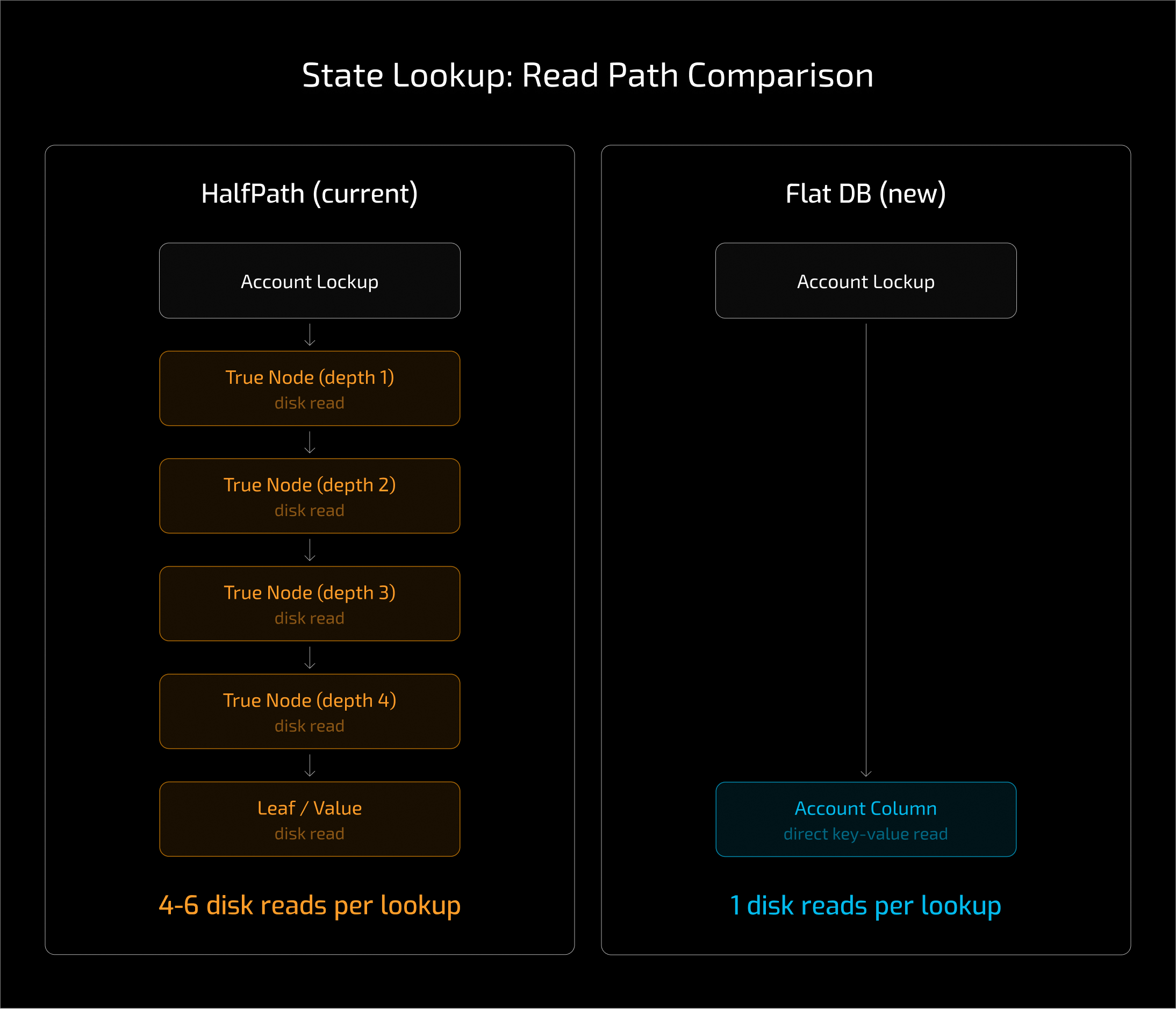
Trie traversal cost on reads. Account and storage lookups still require walking the trie path. Flat DB allows these values to be read directly from flat entries instead.
Reduced trie dependence for reads. This also changes the read path for other workloads. For example, RPC calls often avoid reading the trie entirely, since flat entries are smaller and cheaper to access.
Flat DB addresses this by separating accounts, storage, and trie nodes into different columns, and by skipping trie traversal entirely for read-only workloads.
Figure 1: A single account lookup under HalfPath requires traversing 4–6 trie nodes, each a potential disk read. Flat DB resolves the same lookup directly from a flat key-value column in one read. The trie is still maintained separately for root verification.
Flat DB also reduces the amount of data read during state access. Trie entries are significantly larger than flat entries, which increases bandwidth and memory overhead during traversal. In testing, trie based reads required substantially more data, sometimes up to tens of times larger than flat entries. Direct flat lookups reduce this overhead and improve read performance.
Why Flat DB is hard
Flat state storage has been attempted multiple times. Previous implementations often improved read performance but made state calculation slower during commit. In practice, this offset many of the gains.
Nethermind also already includes aggressive caching and speculative execution. The prewarmer handles a large portion of state reads ahead of execution. This means Flat DB must outperform an already highly optimized read path.
Because of this, improving state access alone is not enough. Flat DB must also address commit time, caching behavior, and memory pressure to deliver meaningful performance improvements.
Architecture Overview
The global state orchestration lives in FlatDbManager which sits on top of an IPersistence abstraction. This allows different database layouts without changing higher level logic. In practice, RocksDB is used.
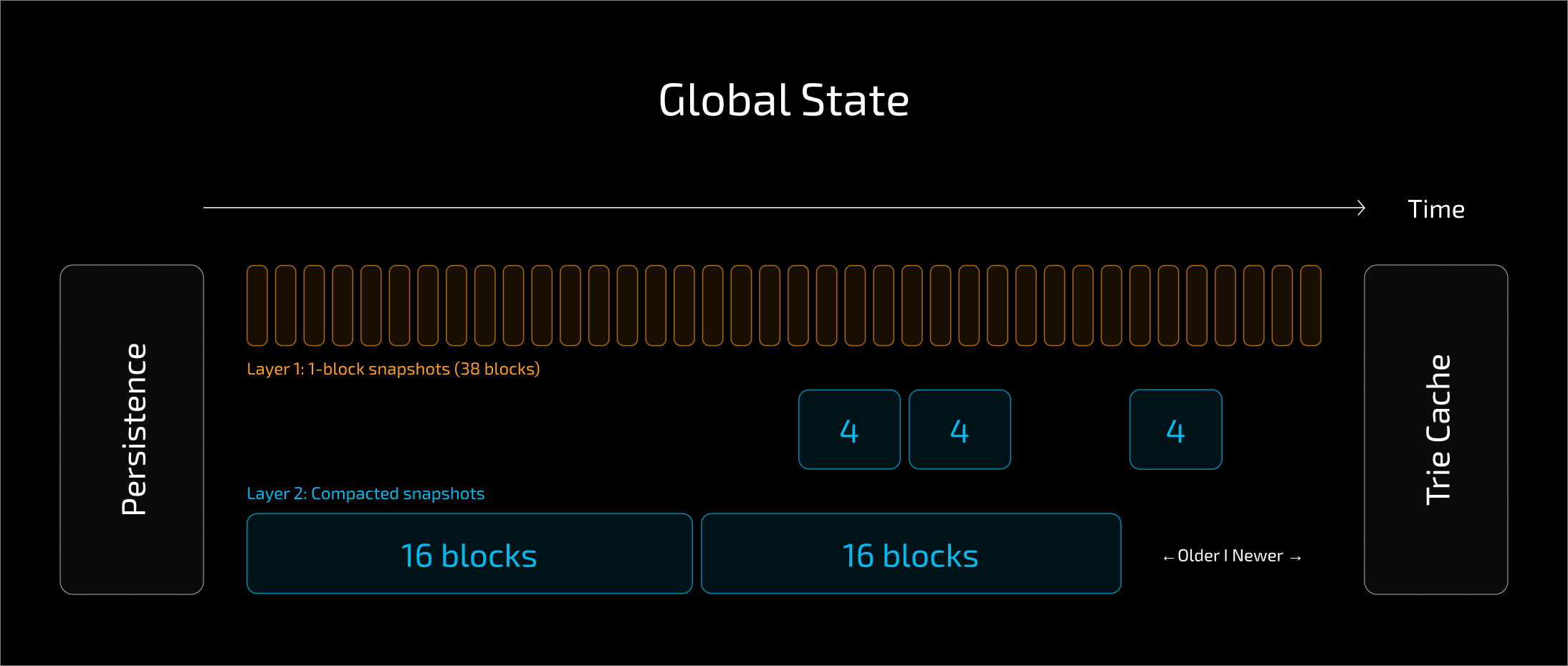
Flat DB introduces two tiers of snapshots. The first tier contains single block snapshots with recent writes. The second tier contains compacted snapshots that aggregate multiple blocks. The size of these compacted snapshots varies depending on block number. Specifically, the size is the largest power of two that divides the block number, up to a configurable maximum of 32 blocks.
This keeps the number of snapshot layers logarithmic relative to reorg size. Fewer layers need to be traversed during reads, especially when handling deeper reorgs.
The ReadOnlySnapshotBundle, which is the shared read view used by the world state, typically traverses around 7 layers to satisfy the 128 reorg depth required to serve Snap Sync.
However, block processing still needs to calculate the state root. This means trie nodes still need to be fetched, even with flat state access. Optimizing this path is critical for Flat DB performance.
Two components are central to this optimization:
TrieNodeCache, a sharded hash table indexed by path and hash
TrieNodeWarmer, which prefetches trie nodes to reduce read latency
Without these optimizations, Flat DB is not significantly faster than HalfPath.
Figure 2: The global state layout showing Layer 1 single-block snapshots, Layer 2 compacted snapshots, Persistence, and the Trie Cache.
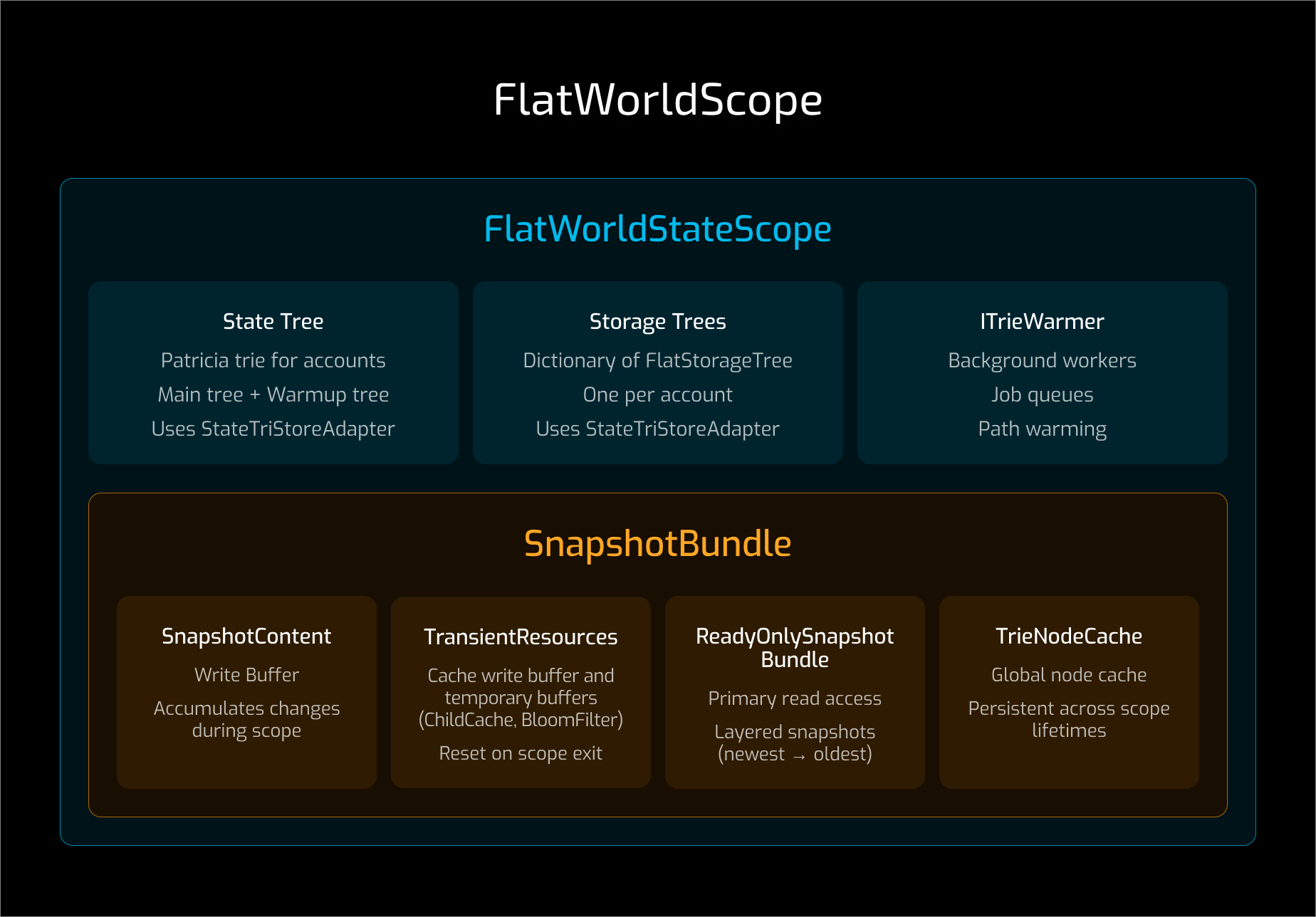
Figure 3: The FlatWorldStateScope component breakdown, showing State Tree, Storage Trees, ITrieWarmer, SnapshotBundle, and TrieNodeCache.
Flat DB relies on snapshot compaction and trie warming to achieve performance improvements. Smaller snapshots are progressively merged into larger compacted snapshots, reducing the number of layers readers must traverse. This helps minimize latency and maintain performance under real workloads, including SnapSync scenarios.
Storage layouts
Flat DB is built on a pluggable persistence layer. The IPersistence abstraction allows different database backends and key layouts without changing higher level state logic.
This makes it easier to experiment with alternate storage engines and layouts for different use cases. The design allows experimentation with databases such as RocksDB, LMDB, or Paprika, as well as different key structures optimized for latency, memory usage, or disk efficiency. However, RocksDB remains the most performant solution so far and is the current production backend.
Flat DB currently includes three layouts with different trade offs:
1. Flat (default)
The default Flat layout is designed for the lowest latency while maintaining functional compatibility. The database is tuned for fast reads and minimal access overhead, even at the expense of higher memory usage. The Flat layout also uses 20 bytes of the hashed address for keys. This reduces CPU overhead during comparisons while maintaining low collision risk.
This includes keeping a larger RocksDB index in memory. On mainnet, this is roughly 2.5 GB of RocksDB index data, which is higher than previous configurations. The goal is to reduce lookup latency during block processing.
The layout uses seven RocksDB columns: Metadata, Account, Storage, StateTopNodes, StateNodes, StorageNodes, and FallbackNodes.
Accounts use slim RLP encoding and are not compressed. Storage keys are structured to help RocksDB comparisons. Top level trie nodes are separated into a dedicated column to reduce compaction pressure and improve cache hit rate.
As measured in April 2026, total database size on mainnet was about 260 GB. This layout is intended for high memory environments, with around 32 GB referenced in testing.
2. PreimageFlat
PreimageFlat is identical to the Flat layout, except account and storage keys use raw values instead of hashed keys.
Because keys are not hashed, this layout cannot support sync. It cannot import existing state or use snap sync. As a result, it is primarily intended for experimentation.
In theory, removing key hashing should reduce lookup overhead and improve performance. However, measuring the performance difference is difficult, since the layout cannot currently import or snap sync.
PreimageFlat therefore exists mainly as an experimental configuration to evaluate the impact of key hashing on state access performance.
3. FlatInTrie
FlatInTrie is designed for environments where memory is constrained, or where the network state is large enough that the memory overhead of the Flat layout becomes unacceptable.
Instead of maintaining separate flat columns, FlatInTrie embeds account and storage data within trie related columns. This significantly reduces the amount of index data kept in memory. The always resident index size is only a few megabytes.
The smaller database size also improves operating system cache utilization, which can help reduce disk access overhead in memory constrained environments.
The trade off is performance. FlatInTrie is noticeably slower than the default Flat layout, since more lookups rely on compressed storage and partitioned indexes rather than large in memory indexes.
FlatInTrie is therefore intended for lower memory machines or very large networks, where memory efficiency is more important than maximum execution throughput.
Performance
During early testing in April 2026, Flat DB showed around 20% higher execution throughput, measured in MGas per second, compared to HalfPath. Flat DB primarily improves slower state access paths. Nethermind already prewarms a large portion of reads during speculative execution. Flat DB reduces latency when these caches miss. The improvement becomes more noticeable under higher gas limits and storage heavy workloads.
Testing also showed that Flat DB maintains more stable performance under memory pressure. As available memory decreases, trie based layouts degrade more significantly, while flat state access remains more consistent.
In larger stress tests using heavier blocks, improvements of around 40% were also observed in the same April tests.
The improvement comes from reduced trie traversal during reads, lower snapshot traversal depth, and caching of trie nodes.
These results are based on internal testing referenced in the PR discussion. Broader validation across workloads and configurations is still required. Flat DB also reduces raw bandwidth usage during pure state reads, since trie entries are significantly larger than flat entries. However, block processing still requires reading trie nodes to compute the state root. As a result, the overall performance impact can vary depending on workload and the proportion of read versus commit time.
Compacted snapshots can be persisted in the background rather than written block by block, which helps reduce CPU overhead during state persistence
What changes for node operators?
As of Nethermind 2.0.0, Flat DB is production ready and enabled by default. The instability described when this post published applied to the alpha implementation in April 2026.
New syncs use the flat layout by default. Operators who need the previous behavior can select half-path explicitly.
Key considerations:
The default Flat layout is designed for low latency and higher performance, which increases memory usage. Around 32 GB of memory is referenced in testing.
As measured in April 2026, disk usage for the Flat layout was approximately 260 GB on mainnet. Disk usage for HalfPath is still being revalidated, with recent estimates around 200 GB.
Lower memory setups can use FlatInTrie, which reduces memory usage but is noticeably slower.
Sync and data handling
Snap sync support for Flat DB shipped in Nethermind 2.0.0. Coordination is more complex, since consistent state must be maintained across reads at the same block height.
Flat DB introduces snapshot layering and compaction for state data. This changes how state is stored and accessed internally. It does not change block or transaction data.
Current status
Flat DB shipped in Nethermind 2.0.0 and is enabled by default. Long finality is enabled by default, with a maximum reorg depth of 90,000.
Additional tuning and validation are ongoing.
What Flat DB enables next
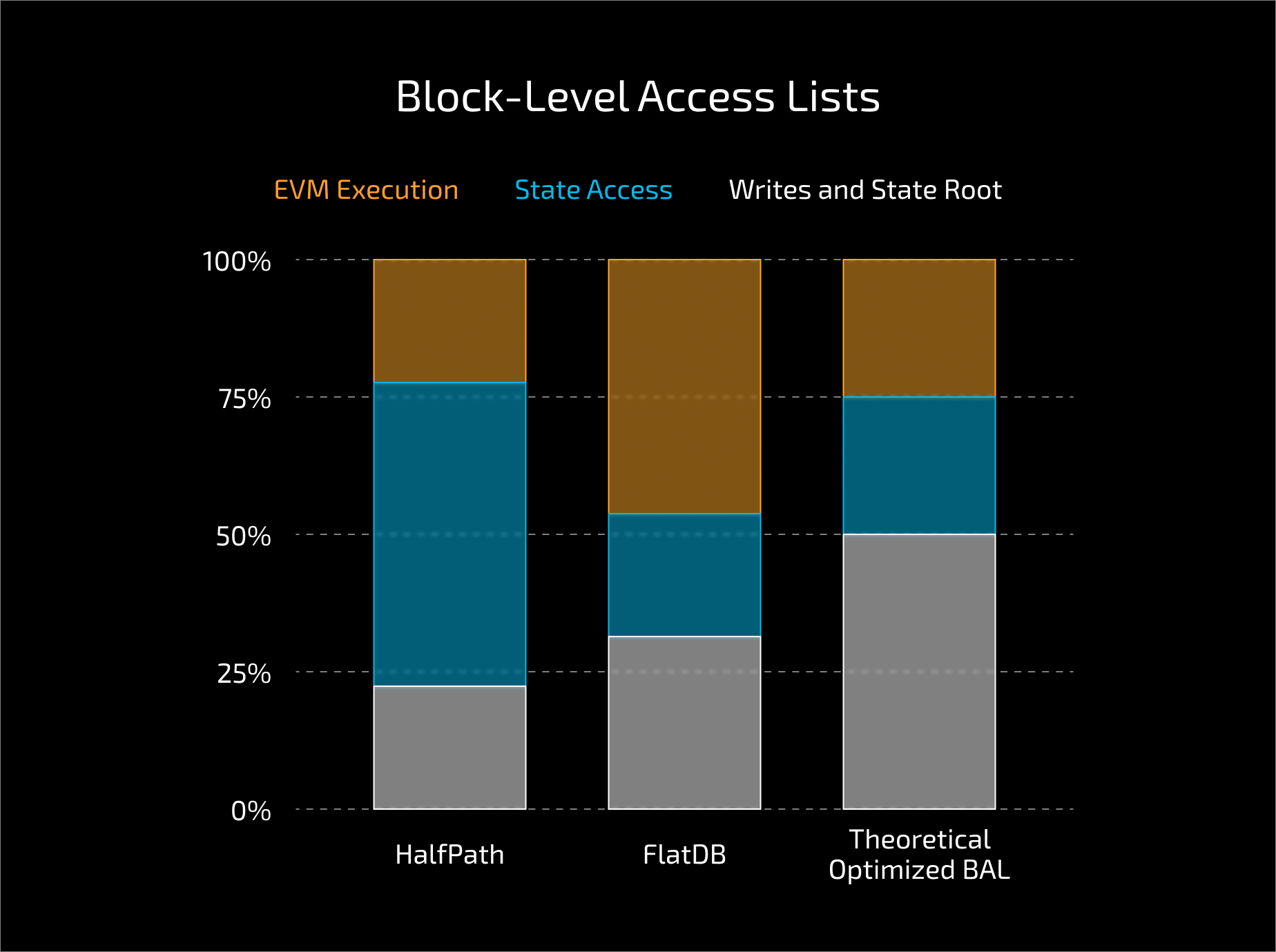
Flat DB reduces the cost of state access during block processing. As execution becomes more parallel and block sizes increase, state access becomes a larger portion of execution time. Reducing state access latency therefore becomes increasingly important.
Figure 4: Time breakdown per block across HalfPath, Flat DB, and a theoretical optimized Block-Level Access List implementation. Flat DB shifts the bottleneck away from state access toward state root calculation, the target of EIP-7928.
Flat DB separates flat state access from trie computation. This creates a cleaner structure for future work and further performance tuning. This includes:
Further tuning of caching and warming
Alternative storage configurations through the persistence abstraction
Continued validation and performance optimization
Flat DB supports a full archive, a rolling window of recent blocks, or per-contract history, all verifiable against block headers.
Flat DB is a foundational change to how Nethermind stores and accesses state. It shipped in 2.0.0, and further validation will determine how it performs across different workloads and environments.