Blockchain security is evolving fast. Vulnerabilities now span ZK circuits, mobile applications, backend infrastructure, and on-chain execution. As protocol architectures evolved, Nethermind Security built the security practice that this reality demands. That shift is reflected in governance roles, standards work, and production engagements. Nethermind Security joined the zkSync Security Council, received governance-level approval from the Arbitrum DAO, and formally verified RISC-V zkVMs where traditional audits cannot provide guarantees.
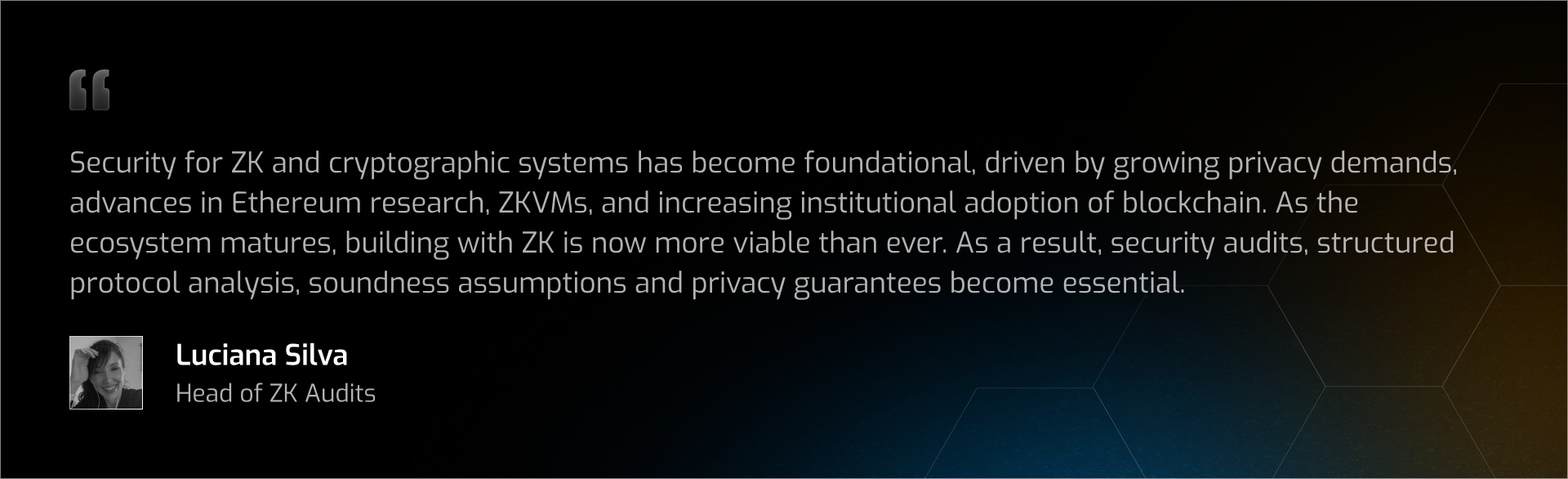
In addition to traditional audits, Nethermind Security conducted ZK-related audits across production deployments, where cryptographic correctness directly underpins protocol safety and user trust. This included work across ZK and cryptographically-heavy systems such as World, Lido, and Celo.
Nethermind Security operated across the full zero-knowledge stack, auditing Layer 2 proving infrastructure and rollup components alongside pure cryptographic protocols and proof system implementations.
Ecosystem Coverage: From Depth to Institutional Trust
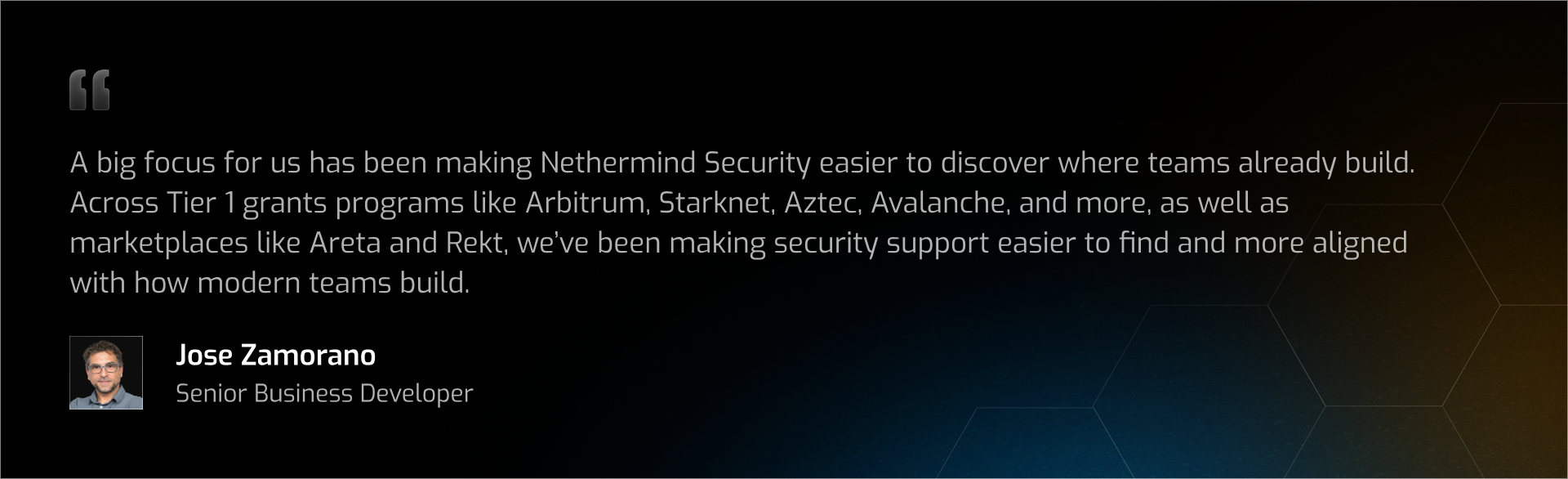
Alongside its ZK focus, Nethermind Security deepened its role within key ecosystems while extending coverage into new execution environments. With zkSync, we contributed to defining security standards as part of the Security Council for the Layer 2 ecosystem as a whole. In Arbitrum, the DAO approved the team as an audit provider under its subsidy framework, reinforcing ecosystem-level trust and discoverability.
Beyond these anchors, Nethermind Security supported a growing range of EVM ecosystems, including Optimism, Hyperliquid, Berachain, Story Protocol, CELO, and Polygon. In parallel, the team continued its work within Starknet, while expanding coverage into additional non-EVM environments such as Aztec and Solana.
This expansion beyond Solidity-only environments enables security coverage for systems that traditional EVM-centric audits cannot address. High-performance chains such as Solana and privacy-focused systems like Aztec operate under fundamentally different assumptions and execution models. Supporting these environments demands different tooling, execution models, and security intuition.
AI-Powered Security: AuditAgent and AgentArena
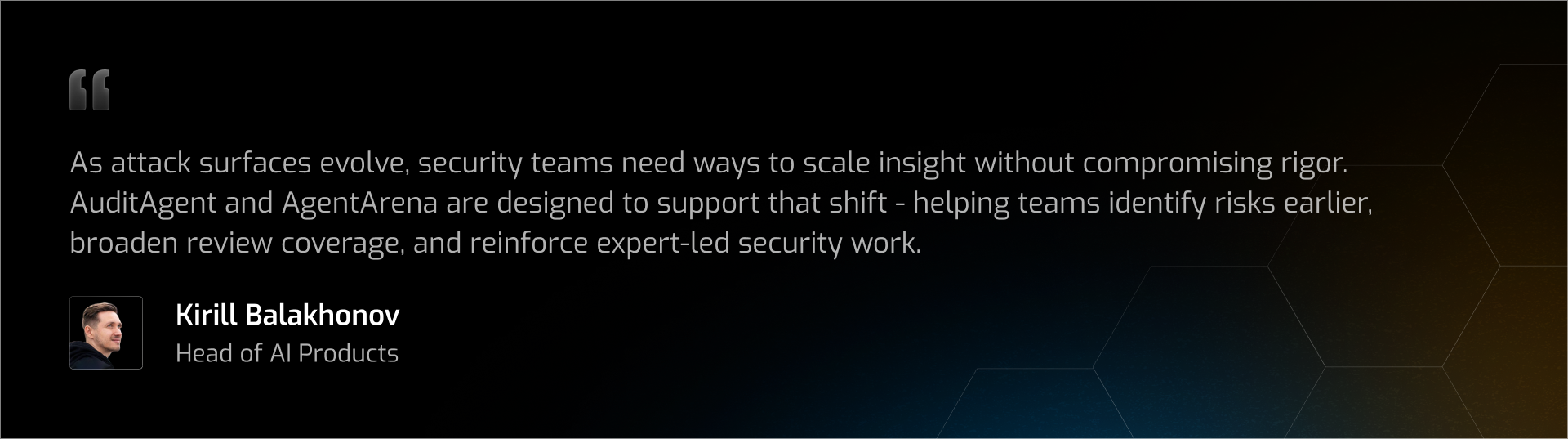
The rapid evolution of artificial intelligence is changing how security work is performed across the software lifecycle. At Nethermind Security, this has led to two complementary initiatives: AuditAgent and AgentArena.
AuditAgent is an AI assisted security layer designed to help teams identify a class of issues earlier, before a formal audit begins. It allows developers to run structured pre audit assessments on smart contracts and related components, helping surface potential risks sooner and improve code readiness before auditors begin manual review.
AgentArena explores a different approach. It expands security coverage by allowing multiple independent agents to analyze the same codebase from different perspectives. Similar to adversarial review or bug bounty dynamics, this model aims to reduce blind spots, increase review coverage at scale, and introduce diverse reasoning strategies into the analysis process.
Together, these initiatives reflect a broader role for AI in security: shifting risk discovery earlier, expanding analytical coverage, and strengthening expert led security review.
AI-Related Security and Emerging Tooling
Nethermind Security contributed a pro bono audit of EIP-8004 in collaboration with the Ethereum Foundation, supporting the security review of an emerging standard related to AI agents. These efforts support internal workflows and client engagements as part of a broader security offering, as AI shapes both how software is built and how it is attacked.
Marketplaces and Discoverability
In parallel with technical expansion, Nethermind Security increased its presence in ecosystem marketplaces to reduce friction for teams seeking security support.
Partnerships That Extend Security Beyond Audits
This year, the team extended security coverage beyond audits through long-term and emerging partnerships. A multi-year collaboration around Forta Firewall continued to support ongoing security coverage, while a newer partnership with Hypernative began to take shape as part of a more comprehensive offering. These relationships support security coverage that extends into production environments.
Formal Verification: Proving Correctness
Traditional audits review code. Formal verification proves correctness mathematically. The distinction matters: we uncovered a soundness bug in Halo2 that traditional reviews missed. We completed the first known formal verification of the functional correctness of RISC-V-based zkVMs, systems where a single failure would directly compromise Ethereum Layer 1 proving. Systems with irreversible consequences demand provable guarantees.
We built general-purpose infrastructure for verifying zero-knowledge circuits using interactive theorem proving, providing reusable verification infrastructure for cryptographic proof systems built on Halo2 and Plonky3.
In parallel, our Formal Verification team contributed to the formalization of core cryptographic protocols through the ArkLib project, funded by the Ethereum Foundation. This work establishes reusable formal models and soundness blueprints for proof systems that underpin modern zero-knowledge infrastructure.
Together, this work establishes formal verification as a non-negotiable layer of security for cryptographic components where failures cannot be mitigated after deployment.
Explore Nethermind Security Services
Nethermind Security provides coverage across the full lifecycle of protocol design, development, and production deployment.
The team also contributes at the ecosystem level through security council participation and standards engagement.
Closing
Nethermind Security established its position across the full stack of blockchain security, from zero-knowledge and identity infrastructure to ecosystem-level standards and production-grade protocol stacks operating under real-world constraints.





.png)
.png)
.png)